Category Archives: nonimmigrant visa

Coming to America to Get Married and Get a Green Card: B-2 or K-1 Visa?

A foreign national who is living overseas and is in a relationship with a U.S. citizen has two main visa options to come to the U.S., get married, and apply for a green card: the B-2 visitor visa and the K-1 fiancé(e) visa. Each route has advantages and disadvantages.

WHAT YOU NEED TO KNOW ABOUT THE B-2 VISITOR VISA

The B-2 visitor visa is for temporary visits only. Entering the U.S. on a B-2 visa and then applying for a marriage-based green card carry benefits and risks.

Benefits of the B-2 to Green Card Route

1. B-2 visa applicant or visa holder does not need a sponsor

An invitation letter or Affidavit of Support from an American sponsor is not required for a B-2 visa. Unlike K-1  fiancé(e) visa applicants, B-2 visa applicants are not required to prove a bona fide relationship with a U.S. citizen significant other.

B-2 visa applicants must instead qualify on the basis of their own residence and ties abroad.  There is no medical exam to complete or immigration-related petition for a U.S. citizen relative to file. They just need to file the online nonimmigrant visa application and pay the application fee.

Legitimate purposes of the B-2 include tourism, vacation (holiday), and visits with friends or relatives. Getting married to a U.S. citizen (or permanent resident) during your visit is not prohibited – as long as you intend to leave the country before your authorized period expires.

2. General desire (and even preconceived intent) to immigrate  – in and of itself – does not prevent B-2 visa holder from adjusting status as the spouse of a U.S. citizen

The B-2 to green card route works best when the foreign national decides to get married to the U.S. citizen only after entering the country. The couple might be undecided about the future of their relationship until they spend more time together during the visit. If the U.S. citizen surprised the B-2 visitor with a marriage proposal after he or she entered the U.S., the visitor could show the original intent was truly a temporary visit.

A general desire to remain in the U.S ., when there is an opportunity to do so legally, is not a problem. Furthermore, a fixed intent to immigrate does not bar immediate relatives (e.g. spouses) of U.S. citizens from adjusting status — unless there are other adverse factors that allow USCIS to deny adjustment as a matter of discretion.

3. Concurrently filing the I-130 and I-485 application (one-step petition/application) is the most streamlined way to get a marriage-based green card

Under normal circumstances, a B-2 visitor who is physically present in the U.S., after lawfully entering the U.S., may file a Form I-485 adjustment of status application at the same time the U.S. citizen files the Form I-130 immigrant petition with U.S. Citizenship & Immigration Services (USCIS). The B-2 to green card route is commonly used by immediate relatives of U.S. citizens.

The one-step filing of the I-485 and I-130 is a much more streamlined process than applying for a K-1 fiancé(e) visa, K-3 nonimmigrant visa, or immigrant visa at the U.S. Consulate overseas, based on marriage to a U.S. citizen. You may also stay with your spouse in the U.S. while your green card application is pending, instead of being separated from each other.

Drawbacks of the B-2 to Green Card Route

1.  B-2 visa applicant or visa holder must show non-immigrant intent

To get the B-2 visa or to enter the U.S. as a visitor, the foreign national must have nonimmigrant intent. You need to prove you have strong ties to your home country that you will not abandon and you will leave the U.S. before your authorized stay expires.

The B-2 visa to green card route works best if you are not yet engaged to the U.S. citizen or did not make specific plans to immigrate to the U.S. after entering the U.S.

Entering the U.S. as a visitor simply to marry a U.S. citizen (or permanent resident) does not violate U.S. immigration law, as long as you leave before your authorized stay expires. While this purpose is legitimate, it still carries risks and may lead to your being denied a visitor visa or entry into the U.S. as a visitor.

If you are applying for a visitor visa, you will be asked on the nonimmigrant visa application, and possibly at the visa interview, whether you have any immediate relatives in the U.S. This includes a fiancé(e). If the consular officer learns you have a U.S. citizen fiancé(e) or believes you will marry the fiancé(e)  during your visit, you will likely be denied a visitor visa. This is because the consular officer might suspect you have no intent of leaving the U.S., but will overstay, get married, and apply for a green card to live permanently in the U.S. with your American spouse.

At the U.S. port of entry, the customs officer may deny your entry for the same reason, even if you present a valid visitor visa. If the U.S. Customs & Border Protection (CBP) finds that you cannot show nonimmigrant intent and therefore lack the proper travel documents, it has two choices. It will either (a) allow you to withdraw your application for admission (and likely revoke your visa) OR, (b) issue an expedited removal order, which bars you from returning to the U.S. for five years, unless you obtain a Form I-212 waiver. Either way, you will be instructed to return home on the next available flight.

In certain situations, the CBP might also find that you willfully misrepresented the purpose of your visit to gain entry into the U.S. as a visitor. It may then deny your entry and issue an expedited removal order on this additional ground. If you cannot convince CBP to refrain from issuing (or to vacate) a charge of willful misrepresentation, you face a lifetime bar to getting a green card or immigrant visa. You will then need to qualify for and obtain an I-601 [INA § 212(i)] waiver of inadmissibility.

I-601 waiver applicants must show  their qualifying relative (U.S. or permanent resident spouse or parent) will suffer “extreme hardship” if they are not admitted to the U.S. as an immigrant. This waiver is challenging to get.

2. Fraud or willful misrepresentation to gain immigration benefits prohibits B-2 visa holder from getting a green card

Lying about the purpose of your visit or about whether you have an American fiancé in the U.S. could be deemed to be fraud or willful misrepresentation to gain immigration benefits.

The U.S. Department of State adopted a 30/60 day rule when a foreign national violates his nonimmigrant status. When a B-2 visa holder marries a U.S. citizen or applies for permanent residence within 30 days of entry,  the DOS presumes that he misrepresented his intent in seeking a visitor visa or entry. If the marriage or green card application occurred between 30 and 60 days of entry, the DOS does not presume, but may content there was misrepresentation. If the marriage or green card application occurred after 60 days, the DOS does not consider such conduct to constitute fraud or willful misrepresentation to obtain immigration benefits.

[UPDATE: On August 1, 2017, the DOS replaced the 30/60 day rule with the 90-day rule, which establishes a presumption of willful misrepresentation “if an alien violates or engages in conduct inconsistent with his or her nonimmigrant status within 90 days of entry.” If such actions occur within 90 days of entry, a consular officer “may presume that the applicant’s representations about engaging in only status-compliant activity were willful misrepresentations of his or her intention in seeking a visa or entry.”]

USCIS is a separate agency from the DOS and the Board of Immigration Appeals has held that immediate relatives are exempt from the 30/60 day rule. Nonetheless, USCIS may use it as a guide.

If USCIS finds you committed fraud or willful misrepresentation to get the B-2 visa or to enter the U.S. as a visitor, this presents a permanent bar to getting a green card. You may also be placed in removal proceedings before the Immigration Court.

You may challenge the finding by showing you did not engage in immigration fraud or willfully misrepresented material facts when you applied for the visa or when you sought entry into the U.S. If you are unable to overcome the finding, you will need to apply for and receive an I-601 waiver of inadmissibility.

3. Concurrent filing of the I-130 and I-485 (one-step petition/application) involves strict eligibility requirements

The visitor visa is often misused as a way to enter the U.S., get married, and then apply for adjustment of status (green card) to avoid the longer process of applying for a K-1, K-3 or immigrant visa at the U.S. Consulate.

USCIS officers will carefully scrutinize your marriage to confirm it’s bona fide, i.e. entered into with the intent of establishing a life together as spouses, and not to circumvent U.S. immigration laws. You need to present documentary evidence of your shared residence, commingling of financial resources and other factors showing you have a real marriage. You also have to testify consistently and credibly as to the nature of your relationship and courtship.

As the I-485 applicant, you must show you are not inadmissible due to criminal convictions, health-related reasons, immigration violations, or other factors. The USCIS officer may conduct a full review your records (including your visitor visa application) and ask you questions at the interview to verify you are admissible to the U.S. It may investigate your true intent when you applied for the visa or sought entry on the visa.

An immigrant visa must also be available to the I-485 applicant.  If your spouse is a permanent resident, he or she may file an I-130 petition for you, but you may not file for a green card right away due to the backlog in the F2A (spouse of permanent resident) category.

When you are not in the immediate relative (e.g. spouse of U.S. citizen) category, you must be in lawful nonimmigrant status when you file an I-485. You will need to extend or change status to remain lawfully in the U.S. during the wait. Or you might have to wait until your permanent resident spouse becomes a naturalized U.S. citizen. Because adjusting status as the spouse of a permanent resident carries many obstacles, you likely will have to timely depart the U.S. and apply for an immigrant visa at the U.S. Consulate when one becomes available.

WHAT YOU NEED TO KNOW ABOUT THE K-1 FIANCE(E) VISA

The K-1 fiancé(e) visa is for the specific purpose of entering the U.S. to get married to a U.S. citizen and filing for adjustment of status. Entering the U.S. on a K-1 visa and then applying for a marriage-based green card carry benefits and risks.

Benefits of the K-1 to Green Card Route

1. K-1 visa applicant is not required to show nonimmigrant intent

When you apply for a K-1 visa, you are declaring immigrant intent. Getting married to a U.S. citizen and applying for permanent residence are expected. Unlike B-2 visa applicants, K-1 applicants are not required to present evidence of nonimmigrant intent or strong ties to their home country.

2. K-1 visa is the most appropriate visa for marrying a U.S. citizen in the U.S. and applying for a marriage-based green card

As a K-1 entrant, you bear no risk of being found to have committed visa fraud if you marry the U.S. citizen petitioner and apply for a green card, as you indicated you would.  Because you are required to marry the U.S. citizen within 90 days, the Department of State’s 30/60 day rule does not apply at all.

The K-1 to green card route is the most direct path to obtaining a marriage-based green card when you are engaged to a U.S. citizen.

3. Adjustment of status process for the K-1 entrant is generally simpler

A K-1 visa holder who completed the medical exam within the past year to get the visa is not required to do a medical exam for the I-485 application. You just need to submit the vaccination supplement, and not the entire medical report.

The U.S. citizen also does not have to file an I-130 immigrant petition after the marriage occurs. You simply file the I-485 application based on the approved Form I-129F petition, as long as the marriage occurred within 90 days of arrival in the U.S.

USCIS also has discretion to waive adjustment interviews for K-1 and K-2 entrants, i.e. fiancé(e) of U.S. citizen and children of fiancé(e). If the National Benefits Center (NBC) determines that the I-485 application qualifies for an interview waiver, and the Service Center agrees, the K-1 entrant may be granted a green card without an interview at the USCIS Field Office. This is never the case with the B-2 entrant, who must complete a marriage-based green card interview.

Drawbacks of the K-1 to Green Card Route

1. K-1 visa applicant must prove bona fide relationship with U.S. citizen

The K-1 visa option is available only if you are engaged to a U.S. citizen. It is not available if you are not committed to getting married (or you are already married), or if your fiancé(e) is just a permanent resident.

To get the K-1 visa, you must prove you have a real relationship with the U.S. citizen, communicate with each other often, and intend to marry within 90 days of your arrival in the U.S. Documentary evidence includes written correspondences, telephone records, and airline tickets and travel stamps showing the U.S. citizen has visited the K-1 visa applicant.

2. K-1 visa involves strict eligibility requirements

In the wake of the San Bernardino shooting on December 2, in which 14 people were killed after married couple Syed Rizwan Farook and Tashfeen Malik opened fire at a holiday party, Congress began to review the K-1 visa application process. Virginia Rep. Bob Goodlatte Goodlatte, chair of the House Judiciary Committee, opined that USCIS “sloppily approved” Farook’s K-1 visa petition for Malik.  Goodlatte noted that USCIS failed to verify whether the Pakistani national had met her U.S. citizen husband in person before applying for the K-1 visa.

The K-1 visa process requires the couple to meet in person at least once during the two years before the U.S. citizen files the Form I-129F petition for the fiancé(e). Waiver of the in-person meeting requirement is very hard to get.

For USCIS to approve the Form I-129F petition and for the U.S. Consulate to grant the visa, both the U.S. citizen petitioner and foreign national beneficiary must meet other strict eligibility requirements.

For example, a U.S. citizen who has filed two or more K-1 petitions at any time in the past or had any K-1 petition approved within the prior two years may not file a new K-1 petition unless USCIS grants a waiver of these limitations as a matter of discretion. No waiver will be given to a petitioner with a history of violent offenses except in limited circumstances.

3. K-1 to green card route involves a longer, three-step process

You cannot live with your U.S. citizen fiancé(e) in the U.S. until you get the K-1 visa to enter the U.S. The first step of filing the Form I-129F petition and getting it approved usually takes at least 4 to 6 months. The U.S. citizen has to submit a filing fee with the petition.

After USCIS approves the petition, the K-1 applicant must then submit the online nonimmigrant visa application, pay a visa application fee, complete a medical exam, and attend the visa interview.

The U.S. Consulate usually takes several months to schedule a K-1 visa interview. At the visa interview, the U.S. Consulate may require additional documents to confirm the applicant is still in a bona fide relationship with the U.S. citizen. Administrative processing and background checks by the U.S. Consulate can add several more months to the process.

After you enter the U.S. on a K-1 visa, you must marry the U.S. citizen within 90 days of your arrival. Then you must file your I-485 application and pay the filing fee to complete the green card process. If you fail to marry within 90 days, the U.S. citizen spouse will need to file a Form I-130 petition, following marriage outside the 90 days, so you may file a Form I-485 application. If you do not marry at all, you become removable from the U.S. and you cannot adjust through marriage to another U.S. citizen or through any other means.

Although USCIS may waive the adjustment of status interviews for K-1 entrants, it usually does not. Following the San Bernardino shooting, USCIS is expected to waive even fewer interviews. At the interview before USCIS, the couple must prove they have a bona fide marriage and the I-485 applicant must show he or she is admissible to the U.S.

Want to hear about this topic? Check out this video:

WHICH IS BETTER: B-2 or K-1? 

Whether to use the B-2 or K-1 to join your significant other in the U.S. depends on your situation. You need to weigh the advantages and disadvantages of each route when deciding which to take.

Consult an experienced immigration attorney to help you determine whether the B-2 or K-1 is more appropriate for you. Although both can lead to a marriage-based green card, each carries benefits and drawbacks.

This article provides general information only. It is based on law, regulations and policy that are subject to change. Do not consider it as legal advice for any individual case or situation. Each legal case is different and case examples do not constitute a prediction or guarantee of success or failure in any other case. The sharing or receipt of this information does not create an attorney-client relationship.

SUBSCRIBE           CONTACT

Photo by: Dennis Skley

What should you do to get your I-212 Waiver?

Sections 212(a)(9)(A)(i) and (ii) of the Immigration and National Act state that foreign nationals who have been ordered removed may not be readmitted to the U.S. until they have stayed abroad for 5, 10 or 20 years. Having an aggravated felony conviction further subjects you to a permanent bar.

Sections 212(a)(9)(C)(i) and (ii) of the Immigration and National Act state that foreign nationals who illegally enter or attempt to illegally enter the U.S. after certain prior immigration violations are permanently barred.

When any of these inadmissibility bars apply to you, you need an I-212 waiver or Consent to Reapply (CTR) to be readmitted to the U.S. or to obtain a visa as an immigrant or nonimmigrant.

What Must I Submit When Requesting an I-212 Waiver?

A completed and signed Form I-212,  Application for Permission to Reapply for Admission into the United States after Deportation or Removal, must be submitted – except in few situations, such as when filing for a nonimmigrant visa at certain U.S. consulates.

Although the I-212 waiver and Consent to Reapply are two terms that are used interchangeably, a request for a CTR does not always involve the filing of an official Form I-212 and application fee.

The Form I-212 instructions include a list of supporting documents you should submit with your waiver request.

There is no specific statutory standards to be met. Applications are considered on a case-by-case basis, and ALL relevant factors are considered. The approval of the I-212 application is at the agency’s discretion, which means the adjudicator will weigh the favorable and unfavorable factors in making a decision.

To obtain the I-212 waiver, you must establish the favorable factors outweigh the unfavorable factors.

Favorable factors include:

  • Close family ties in the U.S.
  • Unusual hardship to your U.S. citizen or lawful permanent resident relatives, yourself, or your employer in the U.S.
  • Your family responsibilities or intent to hold family responsibilities.
  • Length of lawful presence in the U.S. and the status you held during that presence.
  • Your respect for law and order.
  • Your good moral character, such as lack of criminal history.
  • Reformation and rehabilitation that make it unlikely the problem will occur again (e.g. repeated criminal activity that resulted in your deportation).
  • Eligibility for a waiver of other inadmissibility grounds.
  • The need for your services in the U.S.
  • Absence of significant undesirable or negative factors.
  • Likelihood that you will become a permanent resident in the near future.
  • Considerable passage of time since you were deported.

Unfavorable factors include:

  • Lack of close family ties or hardships.
  • Serious or repeated violations of immigration laws or willful disregard of other laws.
  • Bad moral character, including criminal history.
  • Likelihood that you will seek U.S. welfare or become a public charge.
  • Poor physical or mental condition (unless there is a need for treatment in the U.S., which would be a favorable factor).
  • Unauthorized employment in the U.S.
  • Your admission would be contrary to the welfare, safety, or security of the U.S.
  • Recent deportation.

Personal declarations from you or legal arguments from your lawyer are not enough. You must provide objective and credible evidence, including:

  • Affidavits from third parties attesting to unusual hardships, your good moral character, and other positive factors.
  • Evidence of family ties in the U.S., such as birth certificates and marriage certificates.
  • Medical reports, psychological evaluations, and other records showing unusual hardships to you, your relatives, or others if you are not admitted to the U.S.
  • Evidence of the financial, emotional and psychological impact of family separation.
  • Police clearance reports showing you lack a criminal history.
  • Evidence of rehabilitation and reformation, if you have prior criminal convictions.
  • Employment records and other evidence of your professional qualifications and work experience.
  • Articles and reports on the conditions of the country where you and your family would live if you were not admitted to the U.S.

Generally, your I-212 is more likely to be granted if you are the beneficiary of an approved family or employment-based petition or you are otherwise eligible for a visa,  you have only one removal order, you lack a criminal record, you did not commit serious and repeated immigration violations, and you demonstrate unusual hardships to your family or employer in the U.S. if you are not admitted.

Does Hiring an Immigration Attorney Make a Difference? 

You may file the Form I-212 application on your own. But hiring an experienced, skilled and diligent lawyer provides several advantages, such as:

1.  Avoiding unnecessary expenses and delays. The  immigration lawyer can help you determine whether you need an I-212 waiver in the first place. You might not actually need an I-212 waiver for various reasons, including:

  • The 5, 10 or 20 year bar under INA section 212(a)(9)(A) has expired.
  • You were allowed to withdraw your application for admission at the U.S. port of entry or border and you departed the U.S. within the time specified.
  • You were stopped and refused admission at the U.S. port of entry or border, but no expedited removal order was issued.
  • You were refused admission as an applicant under the Visa Waiver Program.
  • You were paroled into the United States after you accrued more than one year of unlawful presence in the U.S. and left, such that you are not inadmissible under INA section 212(a)(9)(C). [NOTE: You might, however, still be inadmissible under the 3-year/10-year unlawful presence bar and require a separate Form I-601 waiver.]
  • You were paroled into the United States after you were ordered removed from the U.S, such that you are not inadmissible under INA section 212(a)(9)(C). [NOTE: You might, however, still be inadmissible under the 5, 10, or 20-year bar under INA section 212(a)(9)(A) and require a Form I-212 for that bar.]
  • You received voluntary departure from an immigration court and you departed the U.S. during the voluntary departure period.
  • You are applying for I-485 adjustment of status as a U nonimmigrant.

The immigration lawyer also helps ensure that your I-212 waiver application is filled out completely and filed properly with the right immigration agency.  Without a lawyer’s guidance, it can be easy to overlook critical questions and difficult to determine  where you should submit your I-212 application. The lawyer can prevent unnecessary delays, including rejection notices.

2. Determining whether you are inadmissible on other grounds and whether these grounds can be waived or not.  The immigration lawyer will review the immigration court records (including Notice to Appear in Removal Proceedings and court order) or Customs & Border Protection records (including Notice of Expedited Removal) to determine the reasons for your removal and the duration of the bar.

A lawyer can verify  whether you need an I-601 waiver (for immigrant visa) or an I-192 waiver/INA section 212(d)(3)(A)(ii) waiver (for nonimmigrant visa) as well. While the I-212 covers grounds of inadmissibility under INA sections 212(a)(9)(A) or (C), the I-601 waiver or 212(d)(3)(A) waiver is necessary for other grounds, such as immigration fraud and misrepresentation, the 3-year/10-year bar due to previous unlawful presence in the U.S., health conditions, and criminal convictions.

While eligibility requirements for the 212(d)(3)(A) are relatively flexible, they are strict for the I-601 waiver.  Unlike 212(d)(3)(A) waiver applicants, I-601 waiver applicants must have a qualifying relative (e.g. U.S. citizen or permanent resident spouse or parent) who will suffer extreme hardship if they are not admitted to the U.S.

In addition, a lawyer can advise you on whether you are inadmissible for reasons that cannot be waived at all. These include a determination that you made a false claims to U.S. citizenship, a ruling that you filed a frivolous asylum application, a drug conviction after age 18 (except if it was for simple possession of less than 30 grams of marijuana for personal use), and a finding that you entered into a sham marriage to a U.S. citizen for immigration purposes.

3. Increasing the likelihood that your waiver application will be decided favorably (and in some cases, expeditiously). 

An attentive lawyer will strive to understand the full details of your case, including your family responsibilities; the hardships you, your family and/or employer would suffer if you are not admitted to the U.S.; your professional qualifications; and the conditions in your home country.

A skilled and experienced lawyer will advise you on the documentary evidence and written testimonials you must submit to support your waiver request. He or she will also present a legal brief describing how the positive factors outweigh the negative factors and why you deserve the waiver as a matter of discretion, under the law.

A diligent lawyer will also do any necessary follow-ups to obtain an approval, and request expedited processing when appropriate.

***

To present the strongest I-212 waiver request you need to do more than just submit the form and documents listed in the instructions.  True success in getting an I-212 waiver grant is more likely when you have experienced counsel.

Consult an immigration attorney at least once and, preferably, hire a reputable one to help you prepare an approvable I-212 application.

For more information on the inadmissibility grounds that require an I-212 waiver, the limitations of the waiver, and when and where you may file for it, read our related article, When do you need an I-212 Waiver (and how do you get it)?

###

This article provides general information only. It is based on law, regulations and policy that are subject to change. Do not consider it as legal advice for any individual case or situation. Each legal case is different and case examples do not constitute a prediction or guarantee of success or failure in any other case. The sharing or receipt of this information does not create an attorney-client relationship.

SUBSCRIBE           CONTACT

Photo by: Billie

When do you need an I-212 Waiver (and how do you get it)?

iron gateIf you have been removed from the U.S., you are barred from reentering the country for a set number of years or perhaps permanently, depending on why you were removed. Illegal (or attempted illegal) reentries to the U.S., in certain situations, also make you permanently inadmissible.

To be admitted to the U.S. while the bar still applies, you must file for and obtain an I-212 waiver or Consent to Reapply (CTR). Although the two terms are used interchangeably, a CTR request does not always involve the filing on an official Form I-212 and application fee.

When Do I Need an I-212 Waiver or Consent to Reapply?

Sections 212(a)(9)(A)(i) and (ii) of the Immigration and National Act state that foreign nationals who have been ordered removed may not be readmitted to the U.S. until they have stayed abroad for 5, 10 or 20 years. An aggravated felony conviction, however, creates a permanent bar.

Sections 212(a)(9)(C)(i) and (ii) of the Immigration and National Act further state that foreign nationals who illegally enter or attempt to illegally enter the U.S. after certain prior immigration violations are permanently barred.

When you are subject to the 5, 10 or 20 year-bar, you do not need the I-212 waiver if you wait outside the U.S. for the duration of the bar before you seek admission to the U.S. But if you wish to lawfully reenter the U.S. before the time bar expires, you must obtain an I-212 waiver.  And when a permanent bar applies to you, you will forever be required to obtain an I-212 waiver.

An approved Form I-212, Application for Permission to Reapply for Admission into the United States After Deportation or Removal, or Consent to Reapply is valid indefinitely, as long as it is not revoked by the agency that issued the approval.

When the I-212 grant or Consent to Reapply provides permanent relief, it may be used for future immigrant or nonimmigrant purposes, as long as you do not incur new inadmissibility under INA section 212(a)(9)(A) or (C).

Returning unlawfully to the U.S. without the Consent to Reapply may lead to serious consequences, including reinstatement of your removal order, prosecution in criminal court, and a permanent bar from admission to the U.S. (that requires you to wait outside the U.S. for 10 years before you may apply for the waiver).

Five-Year Bar

You have a five-year bar on reentry from the date of your removal if:

  • You were removed upon arrival in the U.S., i.e. ordered removed in an expedited removal proceeding by U.S. Customs & Border Protection (CBP) at a U.S. port of entry. [INA section 212(a)(9)(A)(i)]
  • You were placed in removal proceedings upon arrival in the U.S. and then ordered removed by an immigration judge as an arriving alien. [INA section 212(a)(9)(A)(i)]

Ten-Year Bar

You have a 10-year bar on reentry from the date of your removal if:

  • You were ordered removed, other than as an arriving alien, by an immigration judge in removal proceedings. [INA section 212(a)(9)(A)(ii)]
  • You failed to timely depart the U.S. under an order of voluntary departure issued by an immigration judge, causing the voluntary departure to be converted to removal order.  [INA section 212(a)(9)(A)(ii)]
  • You departed the U.S. willingly, but before removal proceedings were concluded.  [INA section 212(a)(9)(A)(ii)]
  • You left the U.S. while a removal order was outstanding.  [INA section 212(a)(9)(A)(ii)]

Twenty-Year Bar

You have a 20-year bar on reentry from the date of your removal if you were ordered removed from the U.S. more than once, whether as an arriving alien or not.  [INA section 212(a)(9)(A)(ii)]

Permanent Bar

You have a permanent bar on reentry from the date of your removal if:

  • You were convicted of an aggravated felony.  [INA section 212(a)(9)(A)(ii)]. NOTE: For purposes of this permanent bar, it does not matter whether you have been convicted of an aggravated felony in or outside the United States, whether the conviction itself resulted in the removal order, or whether the conviction occurred prior to or after the removal order.
  • You reentered or attempted to reenter the U.S. illegally (without inspection or lawful admission) after you accrued more than one year (in the aggregate) of unlawful presence in the U.S. and left. [INA section 212(a)(9)(C)(i)(I).]
  • You reentered or attempted to reenter the U.S. illegally (without inspection or lawful admission) after you were ordered removed from the U.S. [INA section 212(a)(9)(C)(i)(II)].

Key Things to Know About the Permanent Bar

Permanent Bar Under INA section 212(a)(9)(A)(ii)

The permanent bar, due to an aggravated felony conviction, applies even if you were removed for reasons other than the conviction or you were convicted of the aggravated felony after being removed from the U.S.

Permanent Bar Under INA section 212(a)(9)(C)(i)(I) and (II)

The permanent bar, due to illegal entry or attempted illegal entry, applies only if you accrued the (1+ year) unlawful presence or were ordered removed on or after April 1, 1997, or entered or attempt to reenter the U.S. unlawfully on or after April 1, 1997.

The accrual of unlawful presence is cumulative. For example, if you were unlawfully present for 6 months in 3 different periods (i.e. 18 months total), and you then re-enter the U.S. illegally, you face the permanent bar.

Unlike with the 3/10 year unlawful presence bar under INA 212(a)(9)(B), there are no exceptions for minors and asylees when it comes to the permanent bar. So if you were under 18 when your parent took you to the U.S., you accrued unlawful presence of more than 1 year, you left, and then returned to the U.S. without inspection, you face the permanent bar.

NOTE TO IMMIGRANT VISA APPLICANTS: If you are subject to the permanent bar under INA 212(a)(9)(C)(i) and seek an immigrant visa, you must be outside the U.S. and wait ten years abroad before filing the Form I-212. Based on 2006-2007 Board of Immigration Appeals case law and 2009 USCIS policy, an I-212 application for waiver of this permanent bar cannot be approved unless you are outside the U.S. and at least 10 years have elapsed from your date of departure.

NOTE TO I-360 VAWA SELF-PETITIONERS: If you are a VAWA self-petitioner, you do not have to wait outside the U.S. for 10 years to apply for a separate waiver of the INA 212(a)(9)(C) inadmissibility ground. But you must establish a connection between (i) your battering or subjection to extreme cruelty at the hands of your U.S. citizen or permanent resident spouse and (ii) your removal, departure from the United States, or illegal re-entry into the U.S.

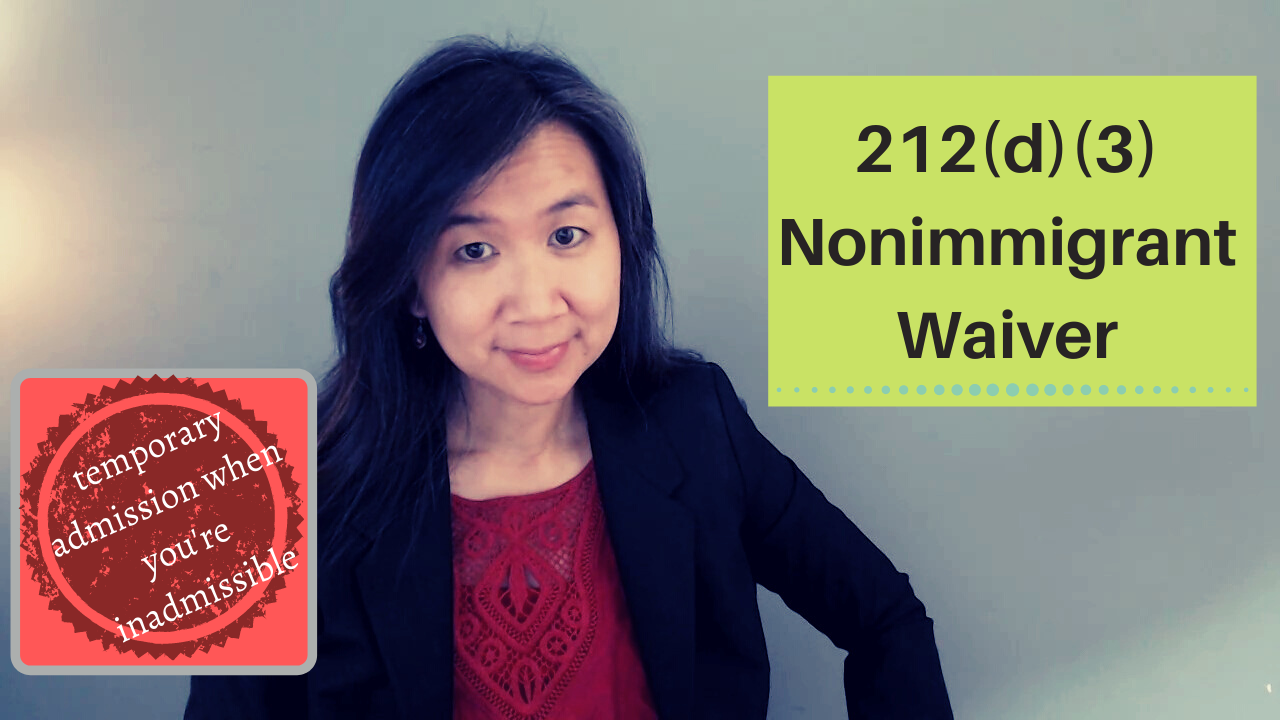
NOTE TO NONIMMIGRANT VISA APPLICANTS: If you are inadmissible under INA 212(a)(9)(C)(i)(I) [9C1] and seek a nonimmigrant visa, you may file for temporary relief at any time through the U.S Consulate.  This is referred to as a 212(d)(3) waiver instead of a Consent to Reapply for Admission. The U.S. Consulate may submit an ARIS Waiver Request Form through the ARIS system. If granted, this relief is temporary and may not be extended to any future visa applications.

If section 212(a)(9)(C)(i)(I) [9C1] is the only inadmissibility ground, and more than ten years have passed since the bar was incurred, you may file the Form I-212 with USCIS (DHS) to obtain a Consent to Reapply. If granted, this relief is permanent and allows the issuance of a full validity visa.

A nonimmigrant visa applicant who is barred under INA 212(a)(9)(C)(i)(II) [9C2] must wait 10 years outside the U.S. before he may file a Form I-212 with USCIS (DHS). ARIS is not used by the U.S. Consulate for this relief. If granted, this allows the issuance of a full validity visa.

What are the Limitations of the I-212 Waiver or Consent to Reapply?

The I-212 waiver or Consent to Reapply alone is generally not enough to request lawful admission to the United States. It only gives you permission to apply for admission with a nonimmigrant visa, immigrant visa or, in some cases, adjustment of status, when you are inadmissible under INA 212(a)(9).

Only visa-exempt citizens of Canada, Palau, Federated States of Micronesia, and the Republic of the Marshall Islands do not need a visa to enter the United States for temporary visits. [NOTE: Being visa-exempt is not the same as being a citizen of a Visa Waiver Program (VWP) country, where the applicant still has to receive authorization under ESTA. ESTA will not be granted to an inadmissible person.]

If your waiver is granted, your prior visa status is not restored. Instead, you merely have permission to apply for a new visa or admission to the United States. For example, if you previously had lawful permanent residence based on marriage to a U.S. citizen, but were removed from the U.S., you must seek a new immigrant visa after the I-212 waiver is granted. If you are now divorced, you will no longer qualify for the immigrant visa based on the same marriage. You may, however, use the I-212 waiver to apply for a visa on another basis.

The I-212 waiver is also not enough if you have other grounds of inadmissibility for which there is no waiver or for which there is a waiver, but you do not qualify.

For instance, fraud or willful misrepresentation of material fact to gain immigration benefits, under INA 212(a)(6)(C)(i), and certain crime-related grounds under INA 212(a)(2) make you permanently inadmissible. An I-601 [INA § 212(i)] immigrant waiver is available to overcome the fraud/willful misrepresentation bar when you have a qualifying relative who will suffer extreme hardship if you are not admitted to the U.S. An I-601 [INA § 212(h)] immigrant waiver is available to some foreign nationals for some criminal grounds. A 212(d)(3) nonimmigrant waiver is available for most inadmissibility grounds.

Where Do I File My Form I-212 Application or Request for Consent to Reapply?

Whether you are in the U.S. or abroad, the reasons you were deported, the type of visa you intend to use to enter the U.S., whether you also need an I-601 waiver, and other factors determine where you file your I-212 application or request for Consent to Reapply.

There are various potential filing locations, including the U.S. Consulate that will issue the visa if the waiver is granted; the U.S. Citizenship and Immigration Services (USCIS) Field Office having jurisdiction over the place of the original removal proceedings; the U.S. Customs and Border Protection (CBP); and the Executive Office for Immigration Review (EOIR). The direct filing addresses for the I-212 are currently posted on the USCIS website.

The current application procedures, which are subject to change, include the following: 

Immigrant visa applicants who also need a concurrent Form I-601 waiver: file Forms I-212 and I-601 concurrently with the USCIS Phoenix Lockbox, which will forward your applications to the Nebraska Service Center.

Immigrant visa applicants who do not require a Form I-601 waiver: file Form I-212 with the USCIS field office having jurisdiction over the place where your removal proceedings were held. The same field office retains jurisdiction to adjudicate the Form I-212 waiver application.

Nonimmigrant visa applicants (other than K, T, U, or V visa applicants): request a Consent to Reapply at the U.S Consulate with jurisdiction over your nonimmigrant visa application.  The consular officer must then forward a recommendation for consent to reapply for admission and visa issuance to the CBP/Admissibility Review Office (ARO) for a decision.

K or V nonimmigrant visa applicants: file Form I-212 with the USCIS Phoenix Lockbox, which will forward your application to the Nebraska Service Center.

Nonimmigrant visa applicants with INA 212(a)(9)(C)(i) bar. If section 212(a)(9)(C)(i)(I) [9C1] is the only inadmissibility ground, and more than 10 years have passed, the Form I-212 is filed with USCIS (DHS). If section 212(a)(9)(C)(i)(II) [9C2] applies, you must wait 10 years before you may file the Form I-212 with USCIS [DHS].

Nonimmigrant visa applicants with the 212(a)(9)(C)(i)(I) [9C1] bar – but NOT the 9C2 bar – may seek temporary relief [212(d)(3) waiver] through the U.S. Consulate at any time.

Nonimmigrants or visa-exempt citizens at a U.S. port of entry who are not required to obtain nonimmigrant visas: file Form I-212 in person at a CBP-designated port of entry or a CBP-designated preclearance office, which will then forward it to the CBP/ARO for adjudication. [UPDATE: Starting in mid-2019, eligible citizens of visa-exempt countries — Canada, Palau, Federated States of Micronesia, and the Republic of the Marshall Islands — file the Form I-192 application through the online system, e-SAFE. Electronic filers need to go to the following ports of entry to complete the biometrics portion (fingerprints and photograph) of the waiver process: Blaine, Washington; Buffalo, New York; and Toronto Pearson International Airport.]

Adjustment of status applicants who are physically present in the U.S. and are inadmissible only under INA section 212(a)(9)(A): file Form I-212 with the USCIS office having jurisdiction over the Form I-485 adjustment of status application, which will adjudicate both applications.

***

Applying for an I-212 waiver or Consent to Reapply involves more than just submitting the form and/or documents listed in the instructions. True success in obtaining an I-212 waiver is more likely when you have experienced counsel.

When you need the I-212 waiver or Consent to Reapply to reenter the U.S., consult an immigration attorney at least once and, preferably, hire a reputable one to guide you through the process from start to finish.

For more information on what to submit with your application and why seeking counsel helps, read our related article, What should you to get your I-212 Waiver? 

###

This article provides general information only. It is based on law, regulations and policy that are subject to change. Do not consider it as legal advice for any individual case or situation. Each legal case is different and case examples do not constitute a prediction or guarantee of success or failure in any other case. The sharing or receipt of this information does not create an attorney-client relationship.

SUBSCRIBE           CONTACT

Photo by: Linda Paul