Posted onJanuary 29, 2016|Comments Off on How to get an I-601 waiver for INA 212(a)(6)(C)(i), immigration fraud or misrepresentation
Section 212(a)(6)(C) of the Immigration & Nationality Act (INA) permanently bars you from immigrating to the U.S. or being lawfully admitted to the U.S. when you have been found to have (1) committed fraud or willful misrepresentation to gain immigration benefits, or (2) made a false claim to U.S. citizenship for any purpose or benefit under immigration, federal or state law.
If you are inadmissible due to fraud or misrepresentation, you need an I-601 waiver, available under INA § 212(i), to get a green card or immigrant visa. There is no waiver for false claims to U.S. citizenship, but you may have defenses and exceptions to establish the bar does not apply to you.
What Must You Submit When Requesting an I-601 [INA § 212(i)] Waiver?
A section 212(i) waiver applicant must submit a completed and signed Form I-601, Application for Waiver of Grounds of Inadmissibility. The Form I-601 filing fee and sometimes a biometrics fee are required.
The Form I-601 instructions include a list of supporting documents you should submit with your waiver request. Examples are affidavits from yourself and third parties describing extreme hardships; expert opinions; medical documentation; and reports of conditions in your home country.
Evidence of extreme hardship
If you qualify for the waiver on the basis that your U.S. citizen or permanent resident spouse, parent, or K visa petitioner will suffer extreme hardship if you are denied admission to the U.S., you must present documentary evidence of the “extreme hardship.”
(NOTE: A U.S. citizen or permanent resident son or daughter is not a qualifying relative for the purpose of proving extreme hardship in an I-601 fraud waiver request.)
Similarly, if you are a VAWA self-petitioner applying for the waiver, you must show the denial of admission will result in “extreme hardship” to yourself (or qualifying relatives).
The agency considers a variety of factors when determining whether there is extreme hardship. They include:
Health: Ongoing or specialized treatment requirements for a physical or mental condition; availability and quality of such treatment in your country, anticipated duration of the treatment; whether a condition is chronic or acute, or long-or short-term; need for applicant to assist with physical or mental conditions.
Financial Considerations: Future employability; loss due to sale of home or business or termination of a professional practice; decline in standard of living; ability to recoup short-term losses; cost of extraordinary needs such as special education or training for children; cost of care for family members (e.g. elderly and sick parents).
Education: Loss of opportunity for higher education; lower quality or limited scope of education options; disruption of current program; requirement to be educated in a foreign language or culture with ensuing loss of time for grade or pay level; availability of special requirements, such as training programs or internships in specific fields.
Personal Considerations: Close relatives in the U.S.; separation from spouse or children; ages of involved parties; length of residence and community ties in the U.S.
Special Factors: Cultural and language barriers; religious and ethnic obstacles; social unrest or civil war in your country; valid fears of persecution, physical harm, or injury; social ostracism or stigma; access to social institutions or structures for support, guidance and protection.
Does Having an Immigration Attorney Make a Difference?
Filling out the Form I-601 is just the first step. The harder part is convincing the agency that you are eligible for the waiver and deserve it as a matter of discretion.
Although “extreme hardship” is not defined by immigration law, it is more than just the normal emotional hardships or financial difficulties that result from family separation or relocation. A good lawyer will help you prove your qualifying relatives will suffer extreme hardship if they are separated from you while you are abroad, or if they move overseas to be with you. If you are a VAWA self-petitioner, the lawyer will also help prove you personally would suffer extreme hardship if you are denied admission.
Immigration fraud/misrepresentation is particularly serious. The presence of aggravating factors (e.g. criminal record) and lack of positive factors (e.g. active involvement in community or volunteer organizations) could lead to a denial of your waiver request. Needing another waiver, such as a section 212(h) waiver (for criminal and related grounds) or a section 212(a)(9)(B)(v) waiver (for unlawful presence), further complicates your case. A good lawyer will help you prove the favorable factors outweigh the unfavorable factors in your case.
It’s much harder to get an I-601 waiver [INA § 212(i) waiver] when you file it on your own and don’t have the benefit of counsel. You have 30 days to file a motion to reopen/reconsider or an appeal if your waiver request is denied. Otherwise, you may re-file the application with new, material evidence. Federal courts lack jurisdiction to review an agency’s decision on an I-601 waiver.
A diligent, experienced immigration attorney will advise you on the documentary evidence to submit, prepare a legal brief explaining how you qualify for the waiver and why you deserve it, and put together a strong waiver application to maximize the chance of success.
This article provides general information only. It is based on law, regulations and policy that are subject to change. Do not consider it as legal advice for any individual case or situation. Each legal case is different and case examples do not constitute a prediction or guarantee of success or failure in any other case. The sharing or receipt of this information does not create an attorney-client relationship.
Posted onJanuary 29, 2016|Comments Off on When do you need an I-601 Waiver due to INA 212(a)(6)(C)(i), immigration fraud or misrepresentation?
An INA 212(a)(6)(C)(i) bar means you were found to have used fraud or willful misrepresentation of a material fact to obtain U.S. immigration benefits.
Without a Form I-601 waiver, you will not be able to adjust to permanent residence or enter the U.S. as an immigrant, K-3 nonimmigrant, or K-1 fiancé(e) visa holder.
When Are You Inadmissible Due to Fraud or Misrepresentation [INA§ 212(a)(6)(C)]?
Section 212(a)(6)(C)(i) of the Immigration & Nationality Act (INA) states that foreign nationals – who by fraud or willfully misrepresenting a material fact, seek to procure (or have sought to procure or have procured) a visa, admission into the United States, or other immigration benefit – are inadmissible.
Section 212(a)(6)(C)(ii) of the INA further states that foreign nationals who have made false claims to U.S. citizenship for any purpose or benefit under immigration law or federal or state law are inadmissible. The one exception is if each natural parent (or each adoptive parent) of the foreign national is or was a U.S. born or naturalized citizen; the foreign national permanently resided in the U.S. prior to turning age 16; and the foreign national reasonably believed at the time of making such false claims that he or she was a citizen.
What is a Retraction and When Does It Count?
A retraction is a withdrawal of a false statement. When it is timely and voluntary, it may serve to purge a misrepresentation and remove it as a basis for INA 212(a)(6)(C)(i)and INA 212(a)(6)(C)(ii) findings. Whether a retraction is timely depends on the circumstances of the case.
Generally, a retraction is timely if it is made at the first opportunity and before the conclusion of the proceeding during which the false statement was given. The retraction must have been made during the initial interview with the officer. It can also be deemed timely and voluntary if it was made in response to an officer’s questions during which the officer gave the applicant a chance to explain or correct a potential misrepresentation.
When Do You Need an I-601 [INA § 212(i)] Waiver Due to Fraud or Misrepresentation?
You need an I-601 waiver under section 212(i) of the INA when you are inadmissible due to fraud or willful misrepresentation and seek an immigrant visa or green card.
You are inadmissible based on fraud if all the following elements exist:
1. You procured, or sought to procure, a benefit under U.S. immigration laws;
2. You made a false representation;
3. The false representation was willfully made;
4. The false representation was material;
5. The false representation was made to a U.S. government official, such as a USCIS officer, U.S. customs officer, or U.S. consular officer;
6. The false representation was made with the intent to deceive a U.S. government official authorized to act upon the request; and
7. The U.S. government official believed and acted upon the false representation by granting the benefit.
If the immigration benefit was denied, you may still be inadmissible for having “sought to procure” it by fraud. Although the fraud element requiring the U.S. government official to believe and act upon the false representation does not apply, an intent to deceive is still a required element.
In cases of attempted fraud, it’s hard for the agency to determine your intent to deceive when the fraud was unsuccessful. You may, however, still be inadmissible for willful misrepresentation, without any finding of fraud.
You are inadmissible based on willful misrepresentation of a material fact if all the following elements exist:
1. You procured, or sought to procure, a benefit under U.S. immigration laws;
2. You made a false representation;
3. The false representation was willfully made;
4. The false representation was material; and
5. The false representation was made to a U.S. government official, such as a USCIS officer, U.S. customs officer, or U.S. consular officer.
If the immigration benefit was granted, you are inadmissible for having procured the benefit by willful misrepresentation. If the immigration benefit was denied, you are still inadmissible for having “sought to procure” it by willful misrepresentation. In each case, an intent to deceive is not required.
If you are inadmissible for fraud, you are also inadmissible for willful misrepresentation. One example is when a person presents a fake (or someone else’s) passport and visa to a U.S. customs officer with the intent of deceiving the officer to gain entry into the U.S. , and the officer admits him based on the false representation. The person is inadmissible for both fraudand willful misrepresentation.
On the other hand, being inadmissible for willful misrepresentation does not necessarily make you inadmissible for fraud. For example, USCIS could find you willfully misrepresented a material fact, but there was no intent to deceive the officer and the officer did not believe and act upon the false representation.
The distinction between fraud and willful misrepresentation, however, is minor. Either way, the lifetime bar under section 212(a)(6)(C)(i) applies. Without the I-601 waiver, you cannot get a green card, an immigrant visa, or a K visa.
What are the Limitations of the I-601 [INA § 212(i)] Waiver?
The I-601 waiver under section 212(i) of the INA has several limitations:
It is limited to immigration fraud or willful misrepresentation of a material fact to obtain immigration benefits. Section 212(i) does not provide an immigrant waiver for false claims to U.S. citizenship to procure immigration benefits or other benefits under federal or state law. Therefore, if you are found inadmissible under section 212(a)(6)(C)(ii), you must show that the bar actually does not apply to you. Potential defenses to a false claim to U.S. citizenship finding include:
1. The false claim was made prior to September 30, 1996, when the law took effect.
2. The false claim was not for a “purpose or benefit” under immigration law or federal or state law.
3. The false claim was not intentionally or knowingly made, particularly if you were a minor at the time.
4. The false claim was made by someone else, without your knowledge or involvement.
5. The false claim was timely and voluntarily retracted, before the lie is exposed or is about to be exposed.
It does not waive prior removal orders and multiple illegal entries. The I-601 waiver does not cover the 5-year, 10-year, and 20-year bar due to prior removal orders. It also does not cover permanent bars caused by multiple unlawful entries into the U.S. To overcome such grounds of inadmissibility, you need to qualify for, seek and obtain an I-212 waiver by filing a Form I-212, Application for Permission to Reapply for Admission into the United States after Deportation or Removal .
It is not a stand-alone application. The section 212(i) waiver request is normally filed in conjunction with an I-485, adjustment of status application or an immigrant, K-3 or K-1 visa application. The waiver request is submitted after USCIS (in the case of an adjustment applicant) or the U.S. Consulate (in the case of an immigrant or K-visa applicant) determines you are inadmissible due to fraud or misrepresentation. The waiver, by itself, confers no immigration benefits, such as permanent residence or employment authorization.
Who Qualifies for the I-601 [INA § 212(i)] Waiver?
To qualify for the I-601 waiver [§ 212(i) waiver] and be excused from the lifetime bar under section 212(a)(6)(C)(i), you must show you are one of the following:
1. An intended immigrant who is the spouse, son or daughter of a U.S. citizen or permanent resident (or the fiance(e) of a U.S. citizen K-visa petitioner) who will suffer extreme hardship if you are not admitted to the U.S.
[NOTE: Being a parent of a U.S. citizen or permanent resident child does not make you eligible for the §212(i) waiver.]
2. A VAWA self-petitioner who will suffer extreme hardship or whose U.S. citizen, lawful permanent resident, or qualified alien parent or child will suffer extreme hardship if you are not admitted to the U.S.
If you do not qualify for the waiver, you will have to present information, documents, and legal arguments establishing the section 212(a)(6)(C) finding is improperly applied to you. You cannot become a permanent resident unless you get the inadmissibility finding rescinded or you obtain the waiver.
Being eligible for the I-601 waiver does not necessarily mean you will get it. As with other waivers available under the INA, §212(i) waivers are granted in the exercise of discretion. In addition to meeting the statutory requirements, applicants must present evidence showing the positive factors outweigh the negative factors in their case. Even if the applicant is eligible for the waiver, the agency may still deny the request as a matter of discretion.
(NOTE to NONIMMIGRANTS: A special authorization for admission as a nonimmigrant for false claims of U.S. citizenship is available under section 212(d)(3)(A) of the INA. The nonimmigrant 212(d)(3) waiver is also available for fraud or willful misrepresentation. Whether you qualify for the nonimmigrant visa itself is a separate issue.)
Where Do You File An I-601 [INA § 212(i)] Waiver Application?
The §212(i) waiver request is filed on a Form I-601, which is submitted to a designated USCIS lockbox or service center, the USCIS Field Office that is adjudicating the I-485 adjustment of status application, or the Immigration Court (if the person is in removal proceedings).
The filing address for the I-601 application depends on whether you are:
An immigrant visa or K-3/K-1 nonimmigrant visa applicant who was found inadmissible by the U.S. Consulate at the visa interview; or
An adjustment of status applicant who is filing or has already filed the I-485 application with USCIS; or
A VAWA self-petitioner seeking an immigrant visa or adjustment of status.
Because direct filing addresses for the I-601 are subject to change, you must verify this information on the USCIS website.
***
To receive an I-601 waiver for immigration fraud or misrepresentation, you need to do more than just submit the form and documents listed in the instructions. You also have to convince USCIS that you qualify for the waiver and deserve to get it. A qualified immigration attorney can guide you on the documentary evidence to submit and prepare a legal brief to support your waiver request.
This article provides general information only. It is based on law, regulations and policy that are subject to change. Do not consider it as legal advice for any individual case or situation. Each legal case is different and case examples do not constitute a prediction or guarantee of success or failure in any other case. The sharing or receipt of this information does not create an attorney-client relationship.
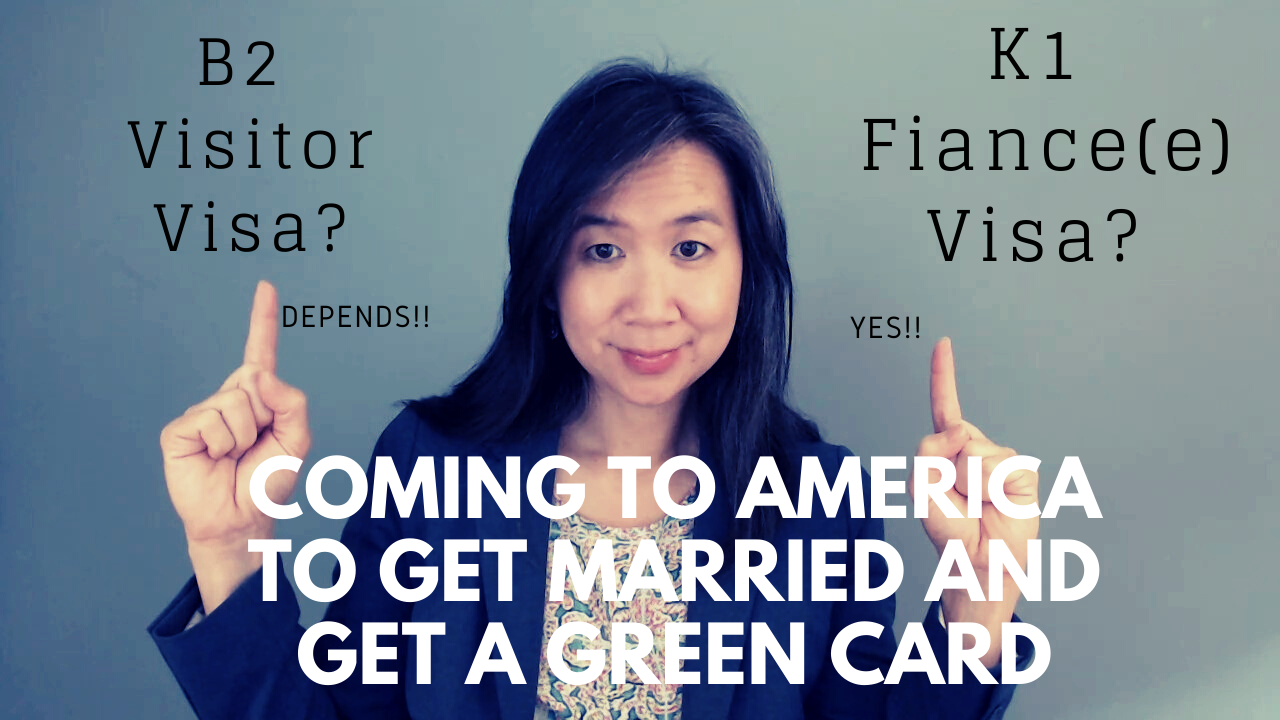
Posted onDecember 30, 2015|Comments Off on Coming to America to Get Married and Get a Green Card: B-2 or K-1 Visa?
A foreign national who is living overseas and is in a relationship with a U.S. citizen has two main visa options to come to the U.S., get married, and apply for a green card: the B-2 visitor visa and the K-1 fiancé(e) visa. Each route has advantages and disadvantages.
WHAT YOU NEED TO KNOW ABOUT THE B-2 VISITOR VISA
The B-2 visitor visa is for temporary visits only. Entering the U.S. on a B-2 visa and then applying for a marriage-based green card carry benefits and risks.
Benefits of the B-2 to Green Card Route
1. B-2 visa applicant or visa holder does not need a sponsor
An invitation letter or Affidavit of Support from an American sponsor is not required for a B-2 visa. Unlike K-1 fiancé(e) visa applicants, B-2 visa applicants are not required to prove a bona fide relationship with a U.S. citizen significant other.
B-2 visa applicants must instead qualify on the basis of their own residence and ties abroad. There is no medical exam to complete or immigration-related petition for a U.S. citizen relative to file. They just need to file the online nonimmigrant visa application and pay the application fee.
Legitimate purposes of the B-2 include tourism, vacation (holiday), and visits with friends or relatives. Getting married to a U.S. citizen (or permanent resident) during your visit is not prohibited – as long as you intend to leave the country before your authorized period expires.
2. General desire (and even preconceived intent) to immigrate – in and of itself – does not prevent B-2 visa holder from adjusting status as the spouse of a U.S. citizen
The B-2 to green card route works best when the foreign national decides to get married to the U.S. citizen only after entering the country. The couple might be undecided about the future of their relationship until they spend more time together during the visit. If the U.S. citizen surprised the B-2 visitor with a marriage proposal after he or she entered the U.S., the visitor could show the original intent was truly a temporary visit.
A general desire to remain in the U.S ., when there is an opportunity to do so legally, is not a problem. Furthermore, a fixed intent to immigrate does not bar immediate relatives (e.g. spouses) of U.S. citizens from adjusting status — unless there are other adverse factors that allow USCIS to deny adjustment as a matter of discretion.
3. Concurrently filing the I-130 and I-485 application (one-step petition/application) is the most streamlined way to get a marriage-based green card
Under normal circumstances, a B-2 visitor who is physically present in the U.S., after lawfully entering the U.S., may file a Form I-485 adjustment of status application at the same time the U.S. citizen files the Form I-130 immigrant petition with U.S. Citizenship & Immigration Services (USCIS). The B-2 to green card route is commonly used by immediate relatives of U.S. citizens.
The one-step filing of the I-485 and I-130 is a much more streamlined process than applying for a K-1 fiancé(e) visa, K-3 nonimmigrant visa, or immigrant visa at the U.S. Consulate overseas, based on marriage to a U.S. citizen. You may also stay with your spouse in the U.S. while your green card application is pending, instead of being separated from each other.
Drawbacks of the B-2 to Green Card Route
1. B-2 visa applicant or visa holder must show non-immigrant intent
To get the B-2 visa or to enter the U.S. as a visitor, the foreign national must have nonimmigrant intent. You need to prove you have strong ties to your home country that you will not abandon and you will leave the U.S. before your authorized stay expires.
The B-2 visa to green card route works best if you are not yet engaged to the U.S. citizen or did not make specific plans to immigrate to the U.S. after entering the U.S.
Entering the U.S. as a visitor simply to marry a U.S. citizen (or permanent resident) does not violate U.S. immigration law, as long as you leave before your authorized stay expires. While this purpose is legitimate, it still carries risks and may lead to your being denied a visitor visa or entry into the U.S. as a visitor.
If you are applying for a visitor visa, you will be asked on the nonimmigrant visa application, and possibly at the visa interview, whether you have any immediate relatives in the U.S. This includes a fiancé(e). If the consular officer learns you have a U.S. citizen fiancé(e) or believes you will marry the fiancé(e) during your visit, you will likely be denied a visitor visa. This is because the consular officer might suspect you have no intent of leaving the U.S., but will overstay, get married, and apply for a green card to live permanently in the U.S. with your American spouse.
At the U.S. port of entry, the customs officer may deny your entry for the same reason, even if you present a valid visitor visa. If the U.S. Customs & Border Protection (CBP) finds that you cannot show nonimmigrant intent and therefore lack the proper travel documents, it has two choices. It will either (a) allow you to withdraw your application for admission (and likely revoke your visa) OR, (b) issue an expedited removal order, which bars you from returning to the U.S. for five years, unless you obtain a Form I-212 waiver. Either way, you will be instructed to return home on the next available flight.
In certain situations, the CBP might also find that you willfully misrepresented the purpose of your visit to gain entry into the U.S. as a visitor. It may then deny your entry and issue an expedited removal order on this additional ground. If you cannot convince CBP to refrain from issuing (or to vacate) a charge of willful misrepresentation, you face a lifetime bar to getting a green card or immigrant visa. You will then need to qualify for and obtain an I-601 [INA § 212(i)] waiver of inadmissibility.
I-601 waiver applicants must show their qualifying relative (U.S. or permanent resident spouse or parent) will suffer “extreme hardship” if they are not admitted to the U.S. as an immigrant. This waiver is challenging to get.
2. Fraud or willful misrepresentation to gain immigration benefits prohibits B-2 visa holder from getting a green card
Lying about the purpose of your visit or about whether you have an American fiancé in the U.S. could be deemed to be fraud or willful misrepresentation to gain immigration benefits.
The U.S. Department of State adopted a 30/60 day rule when a foreign national violates his nonimmigrant status. When a B-2 visa holder marries a U.S. citizen or applies for permanent residence within 30 days of entry, the DOS presumes that he misrepresented his intent in seeking a visitor visa or entry. If the marriage or green card application occurred between 30 and 60 days of entry, the DOS does not presume, but may content there was misrepresentation. If the marriage or green card application occurred after 60 days, the DOS does not consider such conduct to constitute fraud or willful misrepresentation to obtain immigration benefits.
[UPDATE: On August 1, 2017, the DOS replaced the 30/60 day rule with the 90-day rule, which establishes a presumption of willful misrepresentation “if an alien violates or engages in conduct inconsistent with his or her nonimmigrant status within 90 days of entry.” If such actions occur within 90 days of entry, a consular officer “may presume that the applicant’s representations about engaging in only status-compliant activity were willful misrepresentations of his or her intention in seeking a visa or entry.”]
USCIS is a separate agency from the DOS and the Board of Immigration Appeals has held that immediate relatives are exempt from the 30/60 day rule. Nonetheless, USCIS may use it as a guide.
If USCIS finds you committed fraud or willful misrepresentation to get the B-2 visa or to enter the U.S. as a visitor, this presents a permanent bar to getting a green card. You may also be placed in removal proceedings before the Immigration Court.
You may challenge the finding by showing you did not engage in immigration fraud or willfully misrepresented material facts when you applied for the visa or when you sought entry into the U.S. If you are unable to overcome the finding, you will need to apply for and receive an I-601 waiver of inadmissibility.
3. Concurrent filing of the I-130 and I-485 (one-step petition/application) involves strict eligibility requirements
The visitor visa is often misused as a way to enter the U.S., get married, and then apply for adjustment of status (green card) to avoid the longer process of applying for a K-1, K-3 or immigrant visa at the U.S. Consulate.
USCIS officers will carefully scrutinize your marriage to confirm it’s bona fide, i.e. entered into with the intent of establishing a life together as spouses, and not to circumvent U.S. immigration laws. You need to present documentary evidence of your shared residence, commingling of financial resources and other factors showing you have a real marriage. You also have to testify consistently and credibly as to the nature of your relationship and courtship.
As the I-485 applicant, you must show you are not inadmissible due to criminal convictions, health-related reasons, immigration violations, or other factors. The USCIS officer may conduct a full review your records (including your visitor visa application) and ask you questions at the interview to verify you are admissible to the U.S. It may investigate your true intent when you applied for the visa or sought entry on the visa.
An immigrant visa must also be available to the I-485 applicant. If your spouse is a permanent resident, he or she may file an I-130 petition for you, but you may not file for a green card right away due to the backlog in the F2A (spouse of permanent resident) category.
When you are not in the immediate relative (e.g. spouse of U.S. citizen) category, you must be in lawful nonimmigrant status when you file an I-485. You will need to extend or change status to remain lawfully in the U.S. during the wait. Or you might have to wait until your permanent resident spouse becomes a naturalized U.S. citizen. Because adjusting status as the spouse of a permanent resident carries many obstacles, you likely will have to timely depart the U.S. and apply for an immigrant visa at the U.S. Consulate when one becomes available.
WHAT YOU NEED TO KNOW ABOUT THE K-1 FIANCE(E) VISA
The K-1 fiancé(e) visa is for the specific purpose of entering the U.S. to get married to a U.S. citizen and filing for adjustment of status. Entering the U.S. on a K-1 visa and then applying for a marriage-based green card carry benefits and risks.
Benefits of the K-1 to Green Card Route
1. K-1 visa applicant is not required to show nonimmigrant intent
When you apply for a K-1 visa, you are declaring immigrant intent. Getting married to a U.S. citizen and applying for permanent residence are expected. Unlike B-2 visa applicants, K-1 applicants are not required to present evidence of nonimmigrant intent or strong ties to their home country.
2. K-1 visa is the most appropriate visa for marrying a U.S. citizen in the U.S. and applying for a marriage-based green card
As a K-1 entrant, you bear no risk of being found to have committed visa fraud if you marry the U.S. citizen petitioner and apply for a green card, as you indicated you would. Because you are required to marry the U.S. citizen within 90 days, the Department of State’s 30/60 day rule does not apply at all.
The K-1 to green card route is the most direct path to obtaining a marriage-based green card when you are engaged to a U.S. citizen.
3. Adjustment of status process for the K-1 entrant is generally simpler
A K-1 visa holder who completed the medical exam within the past year to get the visa is not required to do a medical exam for the I-485 application. You just need to submit the vaccination supplement, and not the entire medical report.
The U.S. citizen also does not have to file an I-130 immigrant petition after the marriage occurs. You simply file the I-485 application based on the approved Form I-129F petition, as long as the marriage occurred within 90 days of arrival in the U.S.
USCIS also has discretion to waive adjustment interviews for K-1 and K-2 entrants, i.e. fiancé(e) of U.S. citizen and children of fiancé(e). If the National Benefits Center (NBC) determines that the I-485 application qualifies for an interview waiver, and the Service Center agrees, the K-1 entrant may be granted a green card without an interview at the USCIS Field Office. This is never the case with the B-2 entrant, who must complete a marriage-based green card interview.
Drawbacks of the K-1 to Green Card Route
1. K-1 visa applicant must prove bona fide relationship with U.S. citizen
The K-1 visa option is available only if you are engaged to a U.S. citizen. It is not available if you are not committed to getting married (or you are already married), or if your fiancé(e) is just a permanent resident.
To get the K-1 visa, you must prove you have a real relationship with the U.S. citizen, communicate with each other often, and intend to marry within 90 days of your arrival in the U.S. Documentary evidence includes written correspondences, telephone records, and airline tickets and travel stamps showing the U.S. citizen has visited the K-1 visa applicant.
2. K-1 visa involves strict eligibility requirements
In the wake of the San Bernardino shooting on December 2, in which 14 people were killed after married couple Syed Rizwan Farook and Tashfeen Malik opened fire at a holiday party, Congress began to review the K-1 visa application process. Virginia Rep. Bob Goodlatte Goodlatte, chair of the House Judiciary Committee, opined that USCIS “sloppily approved” Farook’s K-1 visa petition for Malik. Goodlatte noted that USCIS failed to verify whether the Pakistani national had met her U.S. citizen husband in person before applying for the K-1 visa.
The K-1 visa process requires the couple to meet in person at least once during the two years before the U.S. citizen files the Form I-129F petition for the fiancé(e). Waiver of the in-person meeting requirement is very hard to get.
For USCIS to approve the Form I-129F petition and for the U.S. Consulate to grant the visa, both the U.S. citizen petitioner and foreign national beneficiary must meet other strict eligibility requirements.
For example, a U.S. citizen who has filed two or more K-1 petitions at any time in the past or had any K-1 petition approved within the prior two years may not file a new K-1 petition unless USCIS grants a waiver of these limitations as a matter of discretion. No waiver will be given to a petitioner with a history of violent offenses except in limited circumstances.
3. K-1 to green card route involves a longer, three-step process
You cannot live with your U.S. citizen fiancé(e) in the U.S. until you get the K-1 visa to enter the U.S. The first step of filing the Form I-129F petition and getting it approved usually takes at least 4 to 6 months. The U.S. citizen has to submit a filing fee with the petition.
After USCIS approves the petition, the K-1 applicant must then submit the online nonimmigrant visa application, pay a visa application fee, complete a medical exam, and attend the visa interview.
The U.S. Consulate usually takes several months to schedule a K-1 visa interview. At the visa interview, the U.S. Consulate may require additional documents to confirm the applicant is still in a bona fide relationship with the U.S. citizen. Administrative processing and background checks by the U.S. Consulate can add several more months to the process.
After you enter the U.S. on a K-1 visa, you must marry the U.S. citizen within 90 days of your arrival. Then you must file your I-485 application and pay the filing fee to complete the green card process. If you fail to marry within 90 days, the U.S. citizen spouse will need to file a Form I-130 petition, following marriage outside the 90 days, so you may file a Form I-485 application. If you do not marry at all, you become removable from the U.S. and you cannot adjust through marriage to another U.S. citizen or through any other means.
Although USCIS may waive the adjustment of status interviews for K-1 entrants, it usually does not. Following the San Bernardino shooting, USCIS is expected to waive even fewer interviews. At the interview before USCIS, the couple must prove they have a bona fide marriage and the I-485 applicant must show he or she is admissible to the U.S.
Want to hear about this topic? Check out this video:
WHICH IS BETTER: B-2 or K-1?
Whether to use the B-2 or K-1 to join your significant other in the U.S. depends on your situation. You need to weigh the advantages and disadvantages of each route when deciding which to take.
Consult an experienced immigration attorney to help you determine whether the B-2 or K-1 is more appropriate for you. Although both can lead to a marriage-based green card, each carries benefits and drawbacks.
This article provides general information only. It is based on law, regulations and policy that are subject to change. Do not consider it as legal advice for any individual case or situation. Each legal case is different and case examples do not constitute a prediction or guarantee of success or failure in any other case. The sharing or receipt of this information does not create an attorney-client relationship.
Posted onDecember 7, 2015|Comments Off on Coming to America to Get Married and Get a Green Card: B-2 or K-1 Visa?
In this video, immigration attorney Dyan Williams describes two types of nonimmigrant visas: B-2 visitor visa and K-1 fiancé(e) visa. She summarizes what you need to know about each visa when using either to come to the U.S., get married to a U.S. citizen or permanent resident, and apply for a green card.
Read about Coming to America to Get Married and Get a Green Card: B-2 or K-1 visa? here.
Contact Dyan for specific advice and guidance on the B-2 visitor visa or K-1 fiance(e) visa to green card process.
This video provides general information and is for educational purposes only. Do not consider it as legal advice for any individual case or situation. Immigration laws, regulations and policies are subject to change. The sharing or receipt of this information does not create an attorney-client relationship.
Posted onNovember 26, 2015|Comments Off on Saying Thanks on Thanksgiving Day
In the United States, we celebrate Thanksgiving today (November 26). In the spirit of this holiday, I’d like to express my gratitude for your connecting with me as a current client, a prospective client, a past client, a referral source, or a friend of Dyan Williams Law PLLC, or a reader of our blog, The Legal Immigrant.
No one wants to talk to a lawyer about their problems. But eventually, most people end up needing to consult with a lawyer.
Foreign nationals who seek to immigrate to the U.S., study or work temporarily in the U.S., or become naturalized U.S. citizens usually need a trusted immigration lawyer to help them figure out the process. A full-on Do-It-Yourself (DIY) approach often gets you into trouble when it comes to navigating the U.S. immigration system. The immigration process is governed by complex laws, changes constantly, and is riddled with confusion and uncertainty.
When prospects call me on the telephone, send me an email, or submit an online inquiry to discuss their case, I strive to make our communication not only comfortable, but also surprisingly pleasant. I speak in layman’s terms they can understand, instead of use legal jargon that is meaningless to them. I ask clarifying questions to understand where they want to go with their case. I provide insightful information to steer them in the right direction.
To give prospects a sense of what it’s like to work with me, I offer a complimentary case evaluation by telephone (and sometimes by email). This involves addressing general concerns and questions about their case. I also write articles and post them on my blog, The Legal Immigrant; participate in a legal Q&A forum that deals with tough immigration issues; and speak to small and large groups on hot immigration topics.
When offering specific and detailed guidance to potential clients, I charge a consultation fee. Why? Two reasons: First, I want to avoid tire kickers who have no intention of working with me, but simply want free advice. Second, I offer tremendous value in the consultation that is worth much more than the fee. When a person is willing to pay the consultation fee, this shows there is some understanding of the value I bring. The consultation is typically the first step to creating a trust-based relationship that makes a huge difference to my clients and their families.
Your contacting me about your case, hiring me as your attorney, or referring others to me is key to having a successful law firm that serves the community well. I appreciate your support and our connection, not just on Thanksgiving Day, but every day.
May you and your family and friends experience joy and gratitude on Thanksgiving Day and beyond.
Cheers,
Dyan Williams
Founder & Principal Attorney
(612) 225-9900
dw@dyanwilliamslaw.com

 Section 212(a)(6)(C) of the Immigration & Nationality Act (INA) permanently bars you from immigrating to the U.S. or being lawfully admitted to the U.S. when you have been found to have (1) committed fraud or willful misrepresentation to gain immigration benefits, or (2) made a false claim to U.S. citizenship for any purpose or benefit under immigration, federal or state law.
 An INA 212(a)(6)(C)(i) bar means you were found to have used fraud or willful misrepresentation of a material fact to obtain U.S. immigration benefits.