Category Archives: waiver

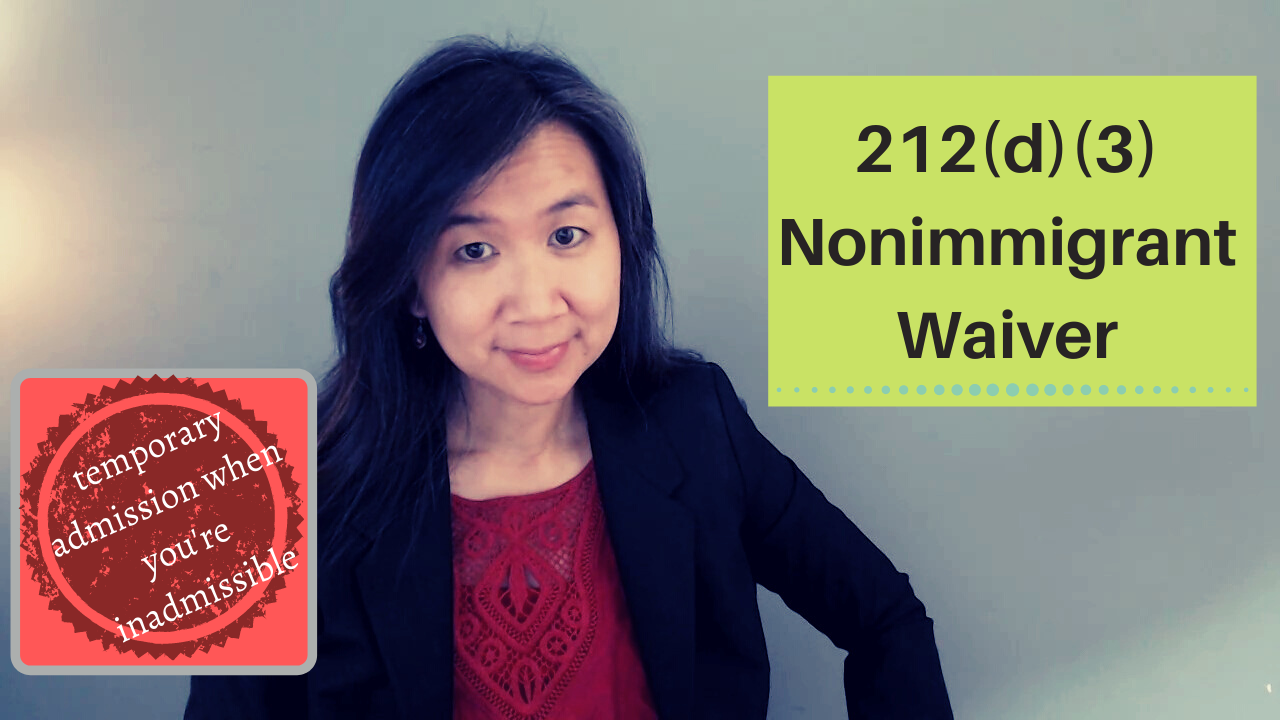
212(d)(3)(A) Nonimmigrant Waiver: Advantages and Disadvantages

Section 212(a) of the Immigration & Nationality Act lists the grounds on which a foreign national is barred from entering the United States. Inadmissible persons may not obtain a nonimmigrant visa (e.g. B-1/B-2 visitor, F-1 student, H-1B worker) or enter the U.S. as a nonimmigrant without a section 212(d)(3) waiver. Visa-exempt persons (e.g. most Canadian citizens) and persons who already have travel documents also need the waiver if they are inadmissible to the U.S.

Although the 212(d)(3) nonimmigrant waiver provides several advantages, it also has disadvantages.

What are the Advantages of the Section 212(d)(3) Nonimmigrant Waiver?

1.  The waiver is broad

For non-immigrants, the 212(d)(3) waiver overcomes almost every ground of inadmissibility listed in section 212(a). This includes health-related grounds, criminal offenses, prostitution, smuggling, fraud or willful misrepresentation of material fact to gain immigration benefits, false claims to U.S. citizenship to gain benefits under federal, state or immigration law, and unlawful presence in the U.S.

2. The waiver is available to almost all non-immigrants

Inadmissible persons who do not qualify for an immigrant waiver often still qualify for a 212(d)(3) waiver.

For example, a foreign national who is inadmissible due to a crime involving moral turpitude within the last 15 years and who has no U.S. citizen or permanent resident spouse, parent, son or daughter for the 212(h) immigrant waiver may enter the U.S. as a nonimmigrant with a 212(d)(3) waiver.

212(d)(3) waiver applicants do not need to show family ties in the U.S. or prove hardships will result if they are not admitted to the U.S. The standards are much higher for 212(a)(9)(B)(v) (unlawful presence) waiver applicants, for example, who must demonstrate a U.S. citizen or permanent resident spouse or parent will suffer extreme hardship if they are not admitted as an immigrant.

A person has a permanent bar under INA 212(a)(9)(C)(i)(I) [9C1] if he reentered or attempted to reenter the U.S. illegally (without inspection or lawful admission) after he accrued more than one year (in the aggregate) of unlawful presence in the U.S. and left. An immigrant visa applicant must wait outside the U.S. for 10 years before he may file for a Consent to Reapply for Admission (permanent relief) to be excused from the 9C1 bar. In contrast, a nonimmigrant visa applicant may seek a 212(d)(3) waiver (temporary relief) through the U.S. Consulate, at any time, to be excused from the same 9C1 bar.

3. The waiver has flexible eligibility standards

The criteria that applicants must meet to get the 212(d)(3) waiver is not defined by statute. In Matter of Hranka, however, the Board of Immigration Appeals listed three factors that must be considered in deciding whether to grant or deny the waiver. They are:

  • The risk of harm to society if the applicant is admitted to the U.S.
  • The seriousness of the applicant’s prior immigration law or criminal law violations, which caused the inadmissibility.
  • The importance of the applicant’s reasons for seeking to enter the U.S.

When reviewing a 212(d)(3) waiver application, the decision-maker applies a balancing test involving these three factors.

The Board stated there is no requirement the applicant’s reasons for wishing to enter the U.S. be “compelling.” The 212(d)(3) waiver is not only for exceptional, humanitarian or national interest cases. It may be granted for any legitimate purpose such as medical treatment (even if available abroad), family visits, school attendance, and tourism. Even applicants with serious criminal convictions, including aggravated felonies, may file for the waiver.

What are the Disadvantages of the Section 212(d)(3) Nonimmigrant Waiver?

1.  The waiver does not overcome every ground of inadmissibility and is not available to all non-immigrants

The 212(d)(3) waiver does not overcome inadmissibility grounds related to:

  • Security-related grounds (e.g. espionage, sabotage) [INA section 212(a)(3)(A)(i)(I) & (II), (3)(A)(ii), (3)(A)(iii)];
  • Foreign policy considerations [INA section (3)(C)];
  • Participation in Nazi persecutions [INA section 3(E)(i)]; or
  • Participation in genocide [INA section 3(E)(ii)]

Persons who are inadmissible under any of these grounds do not qualify for the 212(d)(3) waiver.

In addition, the 212(d)(3) waiver will not be given to K nonimmigrant visa applicants who are inadmissible under INA 212(a) grounds for which there is no immigrant waiver when they file for permanent residence. And if the INA 212(a) ineligibility ground may be waived after (or as a result of the) marriage to the petitioner, the K visa applicant must file a Form I-601, Application for Waiver of Ground of Inadmissibility, not a 212(d)(3) waiver request.

2. The waiver does not cover inadmissibility grounds that must be excused by a Form I-212 approval or grant of Consent to Reapply

Persons who have been previously removed from the U.S.  and are subject to a 5, 10 or 20 year-bar to re-entry [under INA section 212(a)(9)(A)(i) and (ii)] must file a Consent to Reapply or Form I-212, Application for Permission to Reapply for Admission into the United States after Deportation or Removal. 

Furthermore, persons who face the lifetime bar under INA 212(a)(9)(C)(i)(II), i.e. illegal re-entry or attempted illegal re-entry, on or after April 1, 1997, following a removal order, may not use the 212(d)(3) waiver to be excused from this inadmissibility ground. Just like immigrant visa applicants, nonimmigrant visa applicants who are subject to the section 212(a)(9)(C)(i)(II) [9C2] bar must wait outside the U.S. for 10 years before they may file for the Consent to Reapply/Form I-212 waiver.

The Consent to Reapply or “I-212 waiver” must not be confused with the 212(d)(3) waiver. Compared to 212(d)(3) waiver applicants, CTR or Form I-212 applicants must meet higher eligibility standards and evidentiary requirements. For example, close family ties in the U.S. and unusual hardship to U.S. citizen or permanent resident relatives are strong favorable factors in an I-212 application, especially when it is connected to an Immigrant Visa request. These factors are not so important in a 212(d)(3) waiver application and might even work against a person seeking to visit the U.S. temporarily.

3. The grant of the waiver is completely discretionary

It is within the complete discretion of the Admissibility Review Office (ARO), which is part of the U.S. Customs & Border Protection (CBP), to grant the waiver. When you need to receive a visa from the U.S. Consulate, you also first need to convince this agency or the U.S. Department of State to recommend the waiver for the request to be forwarded to CBP.

Qualifying for the waiver doesn’t necessarily mean you will get it. The adjudications officer who weighs the 3 Hranka factors may find the negative factors outweigh the positive factors and deny the waiver request.

There is no formal appeal process. Typically, the only recourse it to file for the waiver again when circumstances change or when more supporting evidence is gathered.

Although the eligibility standards are flexible, the 212(d)(3) waiver is still hard to get, especially when the person is inadmissible due to serious criminal convictions and/or egregious immigration violations. The more recent the violation(s), the higher the obstacles in receiving the waiver.

In addition, to receive most nonimmigrant visas (such as B1/B2 visitor and F-1 student visa), you must overcome the presumption of immigrant intent under INA 214(b). In particular, you need strong ties to a residence abroad that will compel a timely departure from the United States and deter a violation of the terms of the visa. If the U.S. Consulate finds the INA 214(b) requirement is not met, it will not accept or review a 212(d)(3) waiver application.

Validity of the Waiver

The 212(d)(3) waiver may be issued for a maximum period of 5 years or up to the expiration of the visa, whichever is earlier. Normally, the waiver is valid for 1 year, especially for first-time applicants.

[UPDATE: In April 2016, the ARO announced it will generally approve 212(d)(3) waivers for a 5-year period, in both initial and renewal applications filed at the border entry points and at the U.S. Consulate, as of January 2017.  The one exception is for crewmembers whose granted waivers will be valid for two-year periods.]

In all cases, a waiver grant is not transferable to a new visa or to an extension or change of status. The waiver is valid for up 5 years or up to the visa expiration date, whichever is earlier. Once the visa expires, the person normally has to file for a waiver renewal (along with appropriate visa) to re-enter the U.S. as a nonimmigrant.

The authorized period of stay as a nonimmigrant — not the validity period of the waiver — determines when the person must leave the U.S. without violating immigration law.

Filing the 212(d)(3) Nonimmigrant Waiver  

The 212(d)(3) waiver application is filed either with the U.S. Consulate or with the CBP.

Waiver application at the U.S. Consulate

Applicants who need a nonimmigrant visa must file the 212(d)(3)(A)(i) waiver with the U.S. Consulate. When the 212(d)(3) waiver request is filed with the U.S. Consulate, no filing fee and no Form I-92 are required.

After the consular officer reviews your nonimmigrant visa application and makes an initial finding of inadmissibility, you may submit your waiver application on the day of the interview or days after the interview.

Assuming you are otherwise eligible for the visa, but for the inadmissibility bar, the consular officer ought to at least consider your waiver request. If the officer believes the waiver should be granted, he or she will make a favorable recommendation and forward the case to the CBP’s Admissibility Review Office for a final decision. If the officer does not recommend the waiver, the applicant may request review by the Department of State. (NOTE: The waiver application is not forwarded to the CBP’s ARO if the consular officer or Department of State determines the waiver request should be denied.)

If the ARO grants the waiver, the U.S. Consulate then decides whether to actually issue the nonimmigrant visa. Even when the 212(d)(3) waiver is granted, the U.S. Consulate may deny the visa for other reasons, e.g. the B-1/B-2 applicant failed to overcome the presumption of immigrant intent under INA 214(b). A waiver grant facilitates but does not guarantee the issuance of the visa.

Waiver application at the U.S. Port of Entry

Certain nonimmigrants do not require a visa to enter the United States for temporary visits. They include visa-exempt citizens of Canada, Palau, Federated States of Micronesia, and the Republic of the Marshall Islands.  [NOTE: Being visa-exempt is not the same as being a citizen of a Visa Waiver Program (VWP) country, where the applicant still has to receive authorization under ESTA. ESTA will not be granted to an inadmissible person.]

When a visa-exempt person files the 212(d)(3) waiver request with the CBP, a Form I-192, Application for Advance Permission to Enter as a Nonimmigrant , plus the filing fee,  are required. The Form I-192 and accompanying documents should be filed in person with the CBP, months in advance of travel.

[UPDATE: Starting in mid-2019, eligible citizens of visa-exempt countries file the Form I-192 application through the online system, e-SAFE. Electronic filers need to go to the following ports of entry to complete the biometrics portion (fingerprints and photograph) of the waiver process: Blaine, Washington; Buffalo, New York; and Toronto Pearson International Airport. ] 

The CBP will forward the I-192 application and supporting documents to the ARO for further processing.

Exception

Inadmissible persons who are applying for T nonimmigrant status or U nonimmigrant status file the Form I-192 (waiver request) with U.S. Citizenship & Immigration Services (USCIS).

Processing Times

When the 212(d)(3) waiver request is filed with the U.S. Consulate, you can expect a normal processing time of 150 to 180 days before the ARO issues a final determination. The minimum processing time of 60 to 120 days is very rare.

When the 212(d)(3) waiver request is submitted directly to the CBP, you can expect a minimum processing time of 90 to 120 days, but it could be up to 150 to 180 days before the ARO issues a final determination.

Processing times are merely estimates and there can be long delays.

Work with an Immigration Attorney

The 212(d)(3) waiver, by itself, does not allow you to enter the United States. You still need the proper travel documents, including appropriate visa, to seek admission to the United States.

A 212(d)(3) nonimmigrant waiver request should include a cover letter/legal brief, affidavits and supporting evidence demonstrating why you are eligible for the waiver and deserve it as a matter of discretion. Having an experienced immigration attorney guide you through this process will make a positive difference.

For more information, watch the video:

###

This article provides general information only. It is based on law, regulations and policy that are subject to change. Do not consider it as legal advice for any individual case or situation. Each legal case is different and case examples do not constitute a prediction or guarantee of success or failure in any other case. The sharing or receipt of this information does not create an attorney-client relationship.

SUBSCRIBE           CONTACT

Photo by: Hernán Piñera

I-601 waiver or I-601A waiver for unlawful presence?

question markBoth the I-601 waiver and I-601A waiver are used to overcome the 3 year/10 year unlawful presence bar. I-601 waiver and I-601A waiver applicants must have a qualifying relative who will suffer extreme hardship if they are not granted re-entry to the U.S. before the 3 or 10 years pass. But there are key differences between the I-601 waiver and I-601A waiver application.


3 Year/10 Year Unlawful Presence Bar

Section 212(a)(9)(B)(i)(I) of the Immigration & Nationality Act (INA) states the 3 year bar to re-entry applies if you were unlawfully present in the U.S. for more than 180 days, but less than one year, and then depart the U.S. prior to commencement of removal proceedings. The U.S. government adds up all the days you were unlawfully present in the U.S. in a single ongoing period or stay (i.e. continuous period of unlawful presence).

The 3-year bar does not apply if you depart the U.S. after the Notice to Appear in removal proceedings is filed with the immigration court, following service of the NTA on you. But leaving the U.S. while you are in removal proceedings or being issued a removal order carries other immigration consequences.

Section 212(a)(9)(B)(i)(II) of the INA states the 10 year bar to re-entry applies if you were unlawfully present in the U.S. for one year or more, and then depart the U.S. The U.S. government adds up all the days you were unlawfully present in the U.S., even if they were from different periods or stays (i.e. the aggregate period of unlawful presence).

You begin to accrue unlawful presence only after April 1, 1997 and once you turn age 18.

The 3/10 year bar to re-entry is triggered only if you leave the U.S. This does not mean you should never leave the U.S. to legalize your immigration status, but you should know there are risks to your departure. (Illegally re-entering or attempting to illegally re-enter the U.S. further complicates your case and triggers a permanent bar under certain circumstances.)

A person who is inadmissible due to the 3 year/10 year bar may not receive an immigrant visa before the 3 year/10 year bar expires without first obtaining an I-601 waiver or I-601A waiver under section 212(a)(9)(B)(v) of the Immigration & Nationality Act. Only certain immigrants qualify for the waiver.

To determine whether to file an I-601 waiver or I-601A waiver to overcome the unlawful presence bar, you need to know the key differences:

1. The I-601 waiver application may be filed by immigrants who are the spouse or son or daughter of a U.S. citizen or permanent resident. The I-601A waiver may be filed only by immediate relatives of U.S. citizens, under current regulations. [UPDATE: On July 29, 2016, DHS published a final rule expanding the I-601A waiver. As of August 29, 2016, the provisional waiver is available to all eligible applicants.]

An immediate relative is the spouse of a U.S. citizen; child (unmarried and under 21) of a U.S. citizen; or parent of a U.S. citizen (who is over age 21). While having a U.S. citizen child allows the person to file for an I-601A waiver, he still needs a qualifying relative to fully qualify for and receive the waiver, just like regular I-601 waiver applicants.

A qualifying relative is a U.S. citizen or permanent resident spouse or parent.  By statutory law, a U.S. citizen or permanent resident child is not a qualifying relative for obtaining the unlawful presence waiver. Furthermore, like regular I-601 waiver applicants, I-601A waiver applicants must prove the qualifying relative will suffer extreme hardships if they are not admitted to the U.S. before the 3 year/10 year bar expires.

2. I-601 applicants file for the regular waiver on the Form I-601. I-601A applicants file for the provisional waiver on the Form I-601A.

Applicants file for the regular I-601 waiver on a Form I-601, Application for Waiver of Grounds of Inadmissibility. There are similar but different I-601 instructions from those of the I-601A.

On March 4, 2013, USCIS introduced the Form I-601A, Application for Provisional Unlawful Presence Waiver to allow certain immigrant visa applicants to obtain the unlawful presence waiver. There are similar but different I-601A instructions from those of the I-601.

3. The Form I-601 application is submitted after the person departs the U.S. The Form I-601A application is submitted before the person departs the U.S.

The I-601 application may be filed only when the person is outside the U.S. I-601 waiver applicants must first depart the U.S. and attend their visa interview at the U.S. Consulate before they may file for the regular waiver. They bear a higher risk of being separated from their family in the U.S. for 3 or 10 years, if they do not receive the waiver following departure from the U.S.  They must wait for the I-601 decision while they are outside of the U.S. and separated from their family.

The I-601A application may be filed only if the person is physically present in the U.S. I-601A waiver applicants file for the provisional waiver while they are still in the U.S, before they depart the U.S. and attend the visa interview at the U.S. Consulate.

Being granted the provisional waiver increases the likelihood that the U.S. Consulate will issue the immigrant visa at or shortly after the interview.  They may wait for the I-601A decision while they are still in the U.S. with their family. The provisional waiver provides several advantages, but has many limitations. For example, if the U.S. Consulate discovers the visa applicant has prior immigration violations or a criminal history, the approved provisional waiver will be revoked and the applicant has to file for the regular I-601 waiver (if available).

4. The I-601 waiver can be filed in conjunction with an immigrant visa or K visa. The I-601A can be filed only in conjunction with an immigrant visa. 

I-601 applicants may be seeking a  K-3 nonimmigrant or K-1 fiancé(e) visa based on an approved I-129F petition, not just an immigrant visa. In contrast, I-601A applicants must first have an approved I-130 (immigrant visa) petition filed on their behalf by a U.S. citizen petitioner. They also have to first pay the immigrant visa fee before they submit the provisional waiver request.

5. The I-601 waiver can be used to waive additional grounds of inadmissibility, such as criminal convictions and immigration fraud. The I-601A waiver waives only the 3/10 year unlawful presence bar.

The Form I-601 allows the applicant to file for multiple grounds of inadmissibility, such as crime-related grounds and fraud or willful misrepresentation to gain immigration benefits, not just unlawful presence.

Meanwhile, the Form I-601A application cannot be used to waive any grounds but unlawful presence in the U.S. If you are subject to other grounds of inadmissibility, such as a prior removal order, illegal re-entries to the U.S., false claims to U.S. citizenship, immigration fraud, or criminal convictions, you may not file the Form I-601A.

If USCIS determines, based on the record, there is reason to believe you are inadmissible on grounds other than unlawful presence, it will deny your Form I-601A.

In January 2014, USCIS clarified that it will not automatically deny the Form I-601A when the applicant has a criminal history. USCIS will review the entire record to determine whether the criminal offense falls within the “youthful offender” or “petty offense” exception, or is not a crime involving moral turpitude. If any exception applies, USCIS will continue to process the I-601A waiver request and approve it, assuming the requirements are met and a favorable exercise of discretion is appropriate.

Consult an Immigration Attorney

Because there are keys differences between the I-601 waiver and I-601A waiver, you should consult an immigration attorney to help you decide which waiver to file. A reliable attorney can also help you determine whether you need to actually depart the U.S. to apply for an immigrant visa, or whether you may apply for adjustment to permanent resident in the U.S. without leaving the country. (This is important to know because the 3 year/10 year is triggered only if you leave the U.S.)

If you are not eligible to adjust status, and you want to gain permanent residence in the U.S., you will need to depart the U.S. to apply for an immigrant visa. If you are inadmissible due only to the 3 year/10 year unlawful presence bar, the I-601A provisional waiver is the more appropriate waiver. But under current regulations, only immediate relatives of U.S. citizens may file for the I-601A waiver. And if you are inadmissible on multiple grounds, the I-601A waiver will not work.

###

This article provides general information only. It is based on law, regulations and policy that are subject to change. Do not consider it as legal advice for any individual case or situation. Each legal case is different and case examples do not constitute a prediction or guarantee of success or failure in any other case. The sharing or receipt of this information does not create an attorney-client relationship.

SUBSCRIBE           CONTACT

Photo by: Stefan Baudy

What should you do get an I-601 waiver for unlawful presence?

Section 212(a)(9)(B)(i)(I) of the Immigration & Nationality Act (INA) states the 3 year bar to re-entry applies if you were unlawfully present in the U.S. for more than 180 days, but less than one year, and then depart the U.S.  Under section 212(a)(9)(B)(i)(II), the 10 year bar to re-entry applies if you were unlawfully present in the U.S. for one year or more, and then depart the U.S. When you are subject to the 3/10 year unlawful presence bar, you need an I-601 waiver, available under INA § 212(a)(9)(B)(v), to return to the U.S. as an immigrant.

What Must You Submit When Requesting an I-601 [INA § 212(a)(9)(B)(v)] Waiver?

A section 212(a)(9)(B)(v) waiver applicant must submit a completed and signed Form I-601Application for Waiver of Grounds of Inadmissibility. The Form I-601 filing fee and sometimes a biometrics fee are required.

The Form I-601 instructions include a list of supporting documents you should submit with your waiver request. Examples are affidavits from yourself and third parties describing extreme hardships; expert opinions; medical documentation; and reports of conditions in your home country.

Evidence of extreme hardship 

If you qualify for the waiver on the basis that your U.S. citizen or permanent resident spouse, parent, son or daughter, or K visa petitioner, will suffer extreme hardship if you are denied admission to the U.S., you must present documentary evidence of the “extreme hardship.”

Similarly, if you are a VAWA self-petitioner applying for the waiver, you must show the denial of admission will result in “extreme hardship” to yourself (or qualifying relatives).

The agency considers a variety of factors when determining whether there is extreme hardship. They include:

  • Health: Ongoing or specialized treatment requirements for a physical or mental condition; availability and quality of such treatment in your country, anticipated duration of the treatment; whether a condition is chronic or acute, or long-or short-term; need for applicant to assist with physical or mental conditions.
  • Financial Considerations: Future employability; loss due to sale of home or business or termination of a professional practice; decline in standard of living; ability to recoup short-term losses; cost of extraordinary needs such as special education or training for children; cost of care for family members (e.g. elderly and sick parents).
  • Education:  Loss of opportunity for higher education; lower quality or limited scope of education options; disruption of current program; requirement to be educated in a foreign language or culture with ensuing loss of time for grade or pay level; availability of special requirements, such as training programs or internships in specific fields.
  • Personal Considerations: Close relatives in the U.S.; separation from spouse or children; ages of involved parties; length of residence and community ties in the U.S.
  • Special Factors: Cultural and language barriers; religious and ethnic obstacles; social unrest or civil war in your country; valid fears of persecution, physical harm, or injury; social ostracism or stigma; access to social institutions or structures for support, guidance and protection.

Does Having an Immigration Attorney Make a Difference? 

Filling out the Form I-601 is just the first step. The harder part is convincing the agency that you are eligible for the waiver and deserve it as a matter of discretion.

Although “extreme hardship” is not defined by immigration law, it is more than just the normal emotional hardships or financial difficulties that result from family separation or relocation.  A good lawyer will help you prove your qualifying relatives will suffer extreme hardship if they are separated from you while you are abroad, or if they move overseas to be with you. If you are a VAWA self-petitioner, the lawyer will also help prove you personally would suffer extreme hardship if you are denied admission.

The presence of aggravating factors (e.g. criminal record) and lack of positive factors (e.g. active involvement in community or volunteer organizations) could lead to a denial of your waiver request. Needing another waiver, such as a section 212(h) waiver (for criminal and related grounds) or a section 212(i) waiver (for fraud or willful misrepresentation) also complicates your case. A good lawyer will help you prove the favorable factors outweigh the unfavorable factors in your case.

It’s much harder to get an I-601 unlawful presence waiver when you file it on your own and don’t have the benefit of counsel. You have 30 days to file a motion to reopen/reconsider or an appeal if your waiver request is denied. Otherwise, you may re-file the application with new, material evidence. Federal courts lack jurisdiction to review an agency’s decision on an I-601 waiver.

A diligent, experienced immigration attorney will advise you on the documentary evidence to submit, prepare a legal brief explaining how you qualify for the waiver and why you deserve it, and put together a strong waiver application to maximize the chance of success.

* * *

Any period of unlawful presence prior to April 1, 1997 – the date the law went into effect – does not count toward the 3 year/10 year bars.  In addition, a minor who is unlawfully present while under age 18 does not accrue any time toward the 3 or 10 year bars. Upon turning 18, he begins to accrue unlawful presence toward the bars.

For more information on when the 3/10 year bar applies, who qualifies for the I-601 [INA § 212(a)(9)(B)(v)] Waiver, and the limitations of the waiver, read our related article, When do you need an I-601 waiver due to unlawful presence (and how do you get it)?

###

This article provides general information only. It is based on law, regulations and policy that are subject to change. Do not consider it as legal advice for any individual case or situation. Each legal case is different and case examples do not constitute a prediction or guarantee of success or failure in any other case. The sharing or receipt of this information does not create an attorney-client relationship.

SUBSCRIBE           CONTACT

Photo by: kkirugi

When do you need an I-601 waiver due to unlawful presence (and how do you get it)?

no entryWhen a non-citizen (other than a permanent resident) leaves the U.S. after accruing unlawful presence in the U.S. for more than 180 days, the 3 year/10 year bar to re-entry is triggered.  A person who is inadmissible due to unlawful presence may not receive an immigrant, K-3 nonimmigrant, or K-1 fiancé(e) visa before the 3 year/10 year bar expires without first obtaining an I-601 waiver under section 212(a)(9)(B)(v) of the Immigration & Nationality Act. Only certain immigrants qualify for the waiver.

The unlawful presence bar begins to apply once you depart the U.S., even if it is to file for an immigrant visa at the U.S. Consulate.

When Are You Inadmissible Due to Unlawful Presence [INA§ 212(a)(9)(B)(i)]? 

You are unlawfully present in the U.S. if you (a) remain in the U.S. after your period of authorized stay expires (e.g. I-94 admission period expires and you have no pending application or petition to extend, change, or adjust status); or (b) enter the U.S. without being lawfully admitted or paroled (e.g. illegally cross the border without proper inspection).

3-Year Bar

Section 212(a)(9)(B)(i)(I) of the Immigration & Nationality Act (INA) states the 3 year bar to re-entry applies if you were unlawfully present in the U.S. for more than 180 days, but less than one year, and then depart the U.S. prior to commencement of removal proceedings.  The U.S. government adds up all the days you were unlawfully present in the U.S. in a single ongoing period or stay (i.e. continuous period of unlawful presence).

The 3-year bar does not apply if you depart the U.S. after the Notice to Appear in removal proceedings is filed with the immigration court, following service of the NTA on you. But leaving the U.S. while you are in removal proceedings or being issued a removal order carries other immigration consequences.

10-Year Bar

Section 212(a)(9)(B)(i)(II) of the INA states the 10 year bar to re-entry applies if you were unlawfully present in the U.S. for one year or more, and then depart the U.S. The U.S. government adds up all the days you were unlawfully present in the U.S., even if they were from different periods or stays (i.e. the aggregate period of unlawful presence).

When Do You Trigger the 3/10 Year Bar?

The 3/10 year bar to re-entry is triggered once you leave the U.S.   This does not mean you should never the U.S. to legalize your immigration status, but you should know there are risks to your departure.

Whenever possible, you should avoid departing the U.S. for consular processing and instead apply for permanent residence within the U.S. [A common example is when a foreign national overstays his authorized period on a visitor visa, but enters into a bona fide marriage to a U.S. citizen and applies for a marriage-based green card within the U.S. Although the 3 year/10 year bar is not triggered unless he leaves the U.S., he would have to file an I-601  [INA § 212(i)] waiver if charged with another inadmissibility ground, i.e. fraud or willful misrepresentation of a material fact to gain immigration benefits by misusing the visitor visa to enter the U.S.]

The unlawful presence waiver is needed only if you are unable to adjust to permanent resident status within the U.S. and trigger the 3/10 year bar by leaving the U.S. for consular processing of the immigrant visa.

Persons in the U.S. who are ineligible to adjust status typically include:

  • undocumented immigrants who entered the United States without being inspected and admitted or paroled (and do not qualify for 245(i) benefits).
  • crew members aboard a ship or airplane who entered the U.S. on a C-1 visa.
  • persons who entered the U.S. with a K-1 fiancé(e) visa, but never married their U.S. citizen petitioner.
  • persons in the U.S. who failed to maintain nonimmigrant status and are not applying for a green card as an immediate relative of a U.S. citizen or as a K-1 beneficiary who married the U.S. citizen petitioner – unless the failure to maintain status was through no fault of their own or for technical reasons.
  • a J-1 or J-2 exchange visitor who is subject to the 2-year foreign residence requirement and has not met or been granted a waiver of this requirement.

When Do You Need an I-601 [INA § 212 (a)(9)(B)(v)] Waiver Due to Unlawful Presence?

You need to file for and obtain an I-601 waiver under section 212(a)(9)(B)(v) of the INA when you seek to immigrate to the U.S. – through consular processing – before the 3/10 year unlawful presence bar expires.  Getting this waiver allows you to lawfully re-enter the U.S. with an immigrant visa or K-visa without waiting outside the U.S. for 3 or 10 years.

There are certain exceptions to the unlawful presence rules. First, any period of unlawful presence prior to April 1, 1997 – the date the law went into effect – does not count toward the 3 year/10 year bars.

In addition, section 212(a)(9)(B)(iii) of the INA excludes the following persons from accruing unlawful presence:

Minors who are under age 18. A minor who is unlawfully present while under age 18 does not accrue any time toward the 3 or 10 year bars. Upon turning 18, he begins to accrue unlawful presence toward the bars.

Asylees. No period of time in which the applicant has a bona fide asylum application counts toward the unlawful presence bars, unless he worked without employment authorization in the U.S. during this period.

Beneficiary of Family Unity Protection (FUP) under section 301 of the Immigration Act of 1990. If the FUP is approved, unlawful presence does not accrue as of the date of filing.  The mere filing of the FUP application does not stop the accrual of unlawful presence.

Qualified battered spouses and children. A Violence Against Women Act (VAWA) self-petitioner who has been battered or subjected to extreme cruelty by a U.S. citizen/permanent resident spouse or parent may be exempted from the 3 year/10 year bar when there was a substantial connection between the abuse and the unlawful presence.

Victims of severe form of trafficking in persons. A trafficking victim does not accrue unlawful presence toward the 3 year/10 year bar if he demonstrates the trafficking was at least once central reason for the unlawful presence.

Tolling for good cause. By statute, foreign nationals do not accrue unlawful presence, for up to 120 days, toward the 3 year bar, while their application for extension of status (EOS) or change of status (COS) request is pending with USCIS. Certain conditions must also be met: (1) they must have been lawfully admitted or paroled into the U.S.; (2) they must have filed a nonfrivolous EOS or COS request before the authorized stay expired; (3) they did not engage in unauthorized employment.

Through a May 2009 policy, USCIS has extended this statutory exception to cover the entire period during which an EOS or COS application is pending, and to the 10 year bar.

If USCIS approves the EOS or COS request, it will be backdated to when the authorized stay expired so no unlawful presence accrues. If the request is denied, unlawful presence accrues from the date of denial. But if a timely-filed EOS or COS request is denied because it was found to be frivolous (e.g. applicant was never eligible for benefit) or because the applicant engaged in unauthorized employment, unlawful presence accrues as of the date the authorized stay expires.

Being Out of Status Doesn’t Necessarily Mean You Accrue Unlawful Presence

There are situations where you are out of status (i.e. have no lawful nonimmigrant status), but still have authorized stay and therefore do not accrue unlawful presence. For example:

F-1 students or J-1 exchange visitors who are admitted for their duration of stay, and fall out of status, do not begin to accrue unlawful presence toward the 3 year/10 year bar until USCIS (DHS), an Immigration Judge or the Board of Immigration Appeals (BIA) finds they violated their status, in which case unlawful presence will only start to accrue the date after the formal finding is made.

According to a 2009 USCIS policy, adjustment of status applicants do not normally accrue unlawful presence — due to being out status –while their I-485 application is pending. The I-485 must have been filed properly according to regulatory requirements, before removal proceedings began. If the adjustment application is accepted by USCIS and thus technically filed, the applicant is in authorized stay and unlawful presence is tolled (stopped) while the application is pending.

Persons with Temporary Protected Status (TPS) have authorized stay beginning on the date the TPS application is filed, assuming the application is approved. If the TPS application is denied, unlawful presence begins accruing on the date the previous authorized stay expired.

What are the Limitations of the I-601 [INA § 212(a)(9)(B)(v)] Waiver?

The I-601 waiver under section 212(a)(9)(B)(v) of the INA has several limitations:

It does not waive prior removal orders and multiple illegal entries. The I-601 waiver does not cover the 5-year, 10-year, and 20-year bar due to prior removal orders. It also does not cover permanent bars caused by multiple unlawful entries into the U.S. To overcome such grounds of inadmissibility, you need to qualify for, seek and obtain an I-212 waiver by filing a Form I-212, Application for Permission to Reapply for Admission into the United States after Deportation or Removal .

It is not a stand-alone application. The section 212(a)(9)(B)(v) waiver request is normally filed in conjunction with an  immigrant, K-3 or K-1 visa application. The waiver request is submitted after the U.S. Consulate determines you are inadmissible due to the unlawful presence bar. The waiver, by itself, confers no immigration benefits, such as permanent residence or employment authorization.

Who Qualifies for the I-601 [INA § 212(a)(9)(B)(v)] Waiver?

You qualify for the I-601 [§ 212(a)(9)(B)(v)] waiver if you are the spouse or son or daughter of a U.S. citizen or permanent resident (or the fiance(e) of a U.S. citizen K-visa petitioner) who will suffer extreme hardship if you are not admitted to the U.S. Being a parent of a U.S. citizen or permanent resident child does not make you eligible for the unlawful presence waiver.

If you have no qualifying relative, i.e. U.S. citizen or permanent resident spouse or parent, to meet the extreme hardship requirement, you are ineligible for the I-601 immigrant waiver.

NOTE TO APPLICANTS WHO QUALIFY FOR SECTION 204(l) BENEFITS: If the qualifying relative has died, and section 204(l) applies,  USCIS treats the qualifying relative’s death as the equivalent of a finding of extreme hardship. The deceased relative must have been a U.S. citizen or LPR at the time of death.

NOTE TO NONIMMIGRANTS: A 212(d)(3)(A) nonimmigrant waiver for unlawful presence, however, is available even if you have no qualifying relative.  Current USCIS and U.S. Department of State policy further allows the 3/10 year bar to run even if the person returns to the United States in nonimmigrant status with a 212(d)(3) waiver.)

Being eligible for the I-601 waiver does not necessarily mean you will get it.  As with other waivers available under the INA, the §212(a)(9)(B)(v) waiver is granted in the exercise of discretion. In addition to meeting the statutory requirements, you must present evidence showing the positive factors outweigh the negative factors in their case. Even if you eligible for the waiver, the agency may still deny the request as a matter of discretion.

Where Do You File An I-601 [INA § 212(a)(9)(B)(v)]  Waiver Application? 

The §212(a)(9)(B)(v) waiver request is filed on a Form I-601.  The current filing addresses are as follows:

A VAWA self-petitioner seeking an immigrant visa must file the waiver request with the USCIS Vermont Service Center.

An immigrant visa or nonimmigrant K visa applicant must file the waiver request with the USCIS Phoenix Lockbox.

Because direct filing addresses for the I-601 are subject to change, you must verify this information on the USCIS website.

NOTE:  If the unlawful presence bar is your only ground of inadmissibility and you are applying for an immigrant visa, it’s better to file for an I-601A, Provisional Unlawful Presence Waiver, before you leave the U.S., instead of the regular I-601 waiver. You need to know the key differences between the I-601 waiver and I-601A waiver to decide which is more appropriate.

***

Obtaining an I-601 unlawful presence waiver requires more than just submitting the form and documents listed in the instructions. You must also explain to USCIS how the documentary evidence shows you qualify for the waiver and deserve to get it. Experienced counsel can help you prepare a legal brief and present a strong, approvable waiver application.

For more information on what to submit with your application and why seeking counsel helps, read our related article, What should you do get an I-601 Waiver for unlawful presence?

###

This article provides general information only. It is based on law, regulations and policy that are subject to change. Do not consider it as legal advice for any individual case or situation. Each legal case is different and case examples do not constitute a prediction or guarantee of success or failure in any other case. The sharing or receipt of this information does not create an attorney-client relationship.

SUBSCRIBE           CONTACT

Photo by: Elliott Brown

What should you do to get an I-601 waiver for criminal grounds?

Section 212(a)(2) of the Immigration & Nationality Act (INA) permanently bars you from adjusting to permanent residence or being lawfully admitted to the U.S. (either as an immigrant or nonimmigrant) on criminal and related grounds. When you have a lifetime ban due to a Crime Involving Moral Turpitude (CIMT) or controlled substance violation, for example, you need an I-601 waiver, available under INA § 212(h).

What Must You  Submit When Requesting an I-601 [INA § 212(h)] Waiver?

A section 212(h) waiver applicant must submit a completed and signed Form I-601Application for Waiver of Grounds of Inadmissibility. The Form I-601 filing fee and sometimes a biometrics fee are required.

The Form I-601 instructions include a list of supporting documents you should submit with your waiver request. Examples are affidavits from yourself and third parties describing hardships and/or rehabilitation; expert opinions; medical documentation; and reports of conditions in your home country.

Evidence of extreme hardship 

If you qualify for the waiver on the basis that your U.S. citizen or permanent resident spouse, parent, son or daughter, or K visa petitioner, will suffer extreme hardship if you are denied admission to the U.S., you must present documentary evidence of the “extreme hardship.”

The agency considers a variety of factors when determining whether there is extreme hardship. They include:

  • Health: Ongoing or specialized treatment requirements for a physical or mental condition; availability and quality of such treatment in your country, anticipated duration of the treatment; whether a condition is chronic or acute, or long-or short-term; need for applicant to assist with physical or mental conditions.
  • Financial Considerations: Future employability; loss due to sale of home or business or termination of a professional practice; decline in standard of living; ability to recoup short-term losses; cost of extraordinary needs such as special education or training for children; cost of care for family members (e.g. elderly and sick parents).
  • Education:  Loss of opportunity for higher education; lower quality or limited scope of education options; disruption of current program; requirement to be educated in a foreign language or culture with ensuing loss of time for grade or pay level; availability of special requirements, such as training programs or internships in specific fields.
  • Personal Considerations: Close relatives in the U.S.; separation from spouse or children; ages of involved parties; length of residence and community ties in the U.S.
  • Special Factors: Cultural and language barriers; religious and ethnic obstacles; social unrest or civil war in your country; valid fears of persecution, physical harm, or injury; social ostracism or stigma; access to social institutions or structures for support, guidance and protection.

Evidence of rehabilitation| Evidence that your admission would not be against the national welfare, safety, or security of the United States

Evidence of your rehabilitation and evidence that your admission would not harm the national welfare, safety, or security of the U.S. are especially important when you are filing for the waiver on these grounds. Such evidence is also essential to showing the positive factors outweigh the negative factors in your case.

The agency considers several factors when determining whether there is rehabilitation. They include:

  • Passage of time since the last conviction
  • The court order regarding sentence imposed and whether the applicant is likely to commit another offense
  • The applicant’s participation in a rehabilitation program, such as alcohol or drug treatment program, if alcohol or drug use contributed to the crime
  • The applicant’s active involvement in community activities and volunteer work
  • A grant of expungement or pardon
  • A psychological evaluation confirming the crime resulted from a mental problem for which the applicant is being treated

Does Having an Immigration Attorney Make a Difference? 

Filling out the Form I-601 is just the first step. The harder part is convincing the agency that you are eligible for the waiver and deserve it as a matter of discretion.

Although “extreme hardship” is not defined by immigration law, it is more than just the normal emotional hardships or financial difficulties that result from family separation or relocation.  A good lawyer will help you prove your qualifying relatives would suffer extreme hardship if they are separated from you while you are abroad, or if they move overseas to be with you.

The presence of aggravating factors (e.g. conviction for a serious offense, recent convictions) and lack of mitigating factors (e.g. participation in a rehabilitation program) can lead to a denial of your waiver request. Needing another waiver, such as a section 212(i) waiver (for immigration fraud/willful misrepresentation) or a section 212(a)(9)(B)(v) waiver (for unlawful presence), further complicates your case. A good lawyer will help you prove the favorable factors outweigh the unfavorable factors in your case.

It’s much harder to get an I-601 waiver [INA § 212(h) waiver] when you file it on your own and don’t have the benefit of counsel. You have 30 days to file a motion to reopen/reconsider or an appeal if your waiver request is denied. Otherwise, you may re-file the application with new, material evidence. Federal courts lack jurisdiction to review an agency’s decision on an I-601 waiver.

A diligent, experienced immigration attorney will advise you on the documentary evidence to submit, prepare a legal brief explaining how you qualify for the waiver and why you deserve it, and put together a strong waiver application to maximize the chance of success.

For more information on when the crime-related bar applies, who qualifies for the I-601 [INA § 212(h)] Waiver, and the limitations of the waiver, read our related article, When do you need an I-601 Waiver due to criminal grounds (and how do you get it)?

###

This article provides general information only. It is based on law, regulations and policy that are subject to change. Do not consider it as legal advice for any individual case or situation. Each legal case is different and case examples do not constitute a prediction or guarantee of success or failure in any other case. The sharing or receipt of this information does not create an attorney-client relationship.

SUBSCRIBE           CONTACT

Photo by: Tiago Pinheiro