Posted onJanuary 28, 2021|Comments Off on How to Prioritize What Matters: Listen to The Incrementalist, Episode 4
If you feel overwhelmed or you’re constantly rescheduling tasks, you are probably overestimating what you can do each day.
Practice Essentialism: do less, but better, so you will have the highest-quality results, with less stress and less friction. And figure out the One Thing you must do now and do that.
With incremental progress daily and weekly, you can create big results with small and consistent actions. Laser-like focus on your core work add up to make a massive difference in all areas of your life.
When we look at a clock – digital or analog – we see the seconds, minutes and hours passing. The day starts and end, regardless of what we do. The clock tells us we have 24 hours in a day.
Of that, we need about 7 to 8 hours of sleep, 1 hour for a lunch break, and a few more hours for daily routines, errands and so on. We have distractions and interruptions. Also, we’re human: our energy and focus ebb and flow throughout the day.
The maximum time you have for your Most Important Tasks is around 8 hours per day. Your MIT is your core work or your high-value, high-leverage activity. This contributes directly to your success. It helps you create the most important, desired results.
In this episode, I discuss how to set your priorities, which starts with the Brain Dump, continues with the Priority Matrix (Eisenhower Complex), and ends with blocking time and matching your tasks with your energy and focus levels, your environment, and your circumstances.
I cover Essentialism, which involves distinguishing the vital few from the trivial many, and making the necessary trade-offs to tackle what truly matters.
I explain why you need to align your actions with your One Thing, which is what you can do, such that by doing it, makes everything else easier or unnecessary.
Resources Cited:
Greg McKeown – Essentialism: The Disciplined Pursuit of Less
Gary Keller and Jay Papasan – The One Thing: The Surprisingly Simple Truth Behind Extraordinary Results
Cheers, Dyan Williams
P.S. If you like the show and want to help keep it going, please give it a 5-star rating and positive review on Apple Podcasts (from ITunes) or other app! Thank you to all who have expressed their appreciation since the launch. And special shout-out to Graham for the first posted review!
# # #
Dyan Williams is a solo lawyer who practices U.S. immigration law and legal ethics at Dyan Williams Law PLLC. She is also a productivity coach who helps working parents, lawyers, small business owners and other busy people turn their ideas into action, reduce overwhelm, and focus on what truly matters. She is the author of The Incrementalist: A Simple Productivity System to Create Big Results in Small Steps.
Posted onJanuary 21, 2021|Comments Off on Breaking Bad Habits: Listen to The Incrementalist, Episode 3
Building good habits is essential to make a change and sustain a healthy and productive life. Sometimes we also need to break bad habits. They tend to serve you in the moment; the immediate outcome feels good. But over the long run, bad habits hurt you or benefit you very little.
Like good habits, bad habits also give you a dopamine hit. Dopamine is a neurotransmitter that is often called the feel-good hormone. Dopamine fires when you get the thing you crave, and when you anticipate getting that thing.
A dopamine hit is not the same as true happiness, say Dr. Jud Brewer, director of research and innovation at Brown University Mindfulness Center, a psychiatrist and an expert in mindfulness training for treating addictions. To break everyday addictions and bad habits, he recommends you step out of the reactive pattern and just be present with whatever comes up. Use your natural curiosity to learn about the habit loop while you’re in it and become aware of the results of your actions.
There are 4 laws of behavior change, says author, speaker and entrepreneur James Clear. If you want to build a habit, you make it Visible, Attractive, Easy and Satisfying. If you want to stop a habit, you invert the laws. You make it Invisible, Unattractive, Difficult and Unsatisfying.
You might think you have to replace the habit with another to break it. But this is really a last resort. You can untangle the bad habit when you stay mindful, get curious, and invert the 4 laws of behavior change.
“Learn how your mind works, so you can work with it.” – Dr. Jud Brewer
“You do not rise to the level of your goals. You fall to the level of your systems.” – James Clear
Resources Cited:
Jud Brewer – The Craving Mind: From Cigarettes to Smartphones to Love – Why We Get Hooked and How We Can Break Bad Habits
James Clear – Atomic Habits: An Easy & Proven Way to Build Good Habits & Break Bad Ones
Here’s to breaking bad habits,
Dyan Williams
# # #
Dyan Williams is a solo lawyer who practices U.S. immigration law and legal ethics at Dyan Williams Law PLLC. She is also a productivity coach who helps working parents, lawyers, small business owners and other busy people turn their ideas into action, reduce overwhelm, and focus on what truly matters. She is the author of The Incrementalist: A Simple Productivity System to Create Big Results in Small Steps.
Posted onJanuary 14, 2021|Comments Off on Listen to The Incrementalist: Episode 2, Building Good Habits
Whenever we want to make a change, we tend to think in terms of goals and outcomes, hopes and dreams. It’s good to know the results we want. But how do we get there? It starts with building good habits that add up over time to create success as you define it.
A habit starts with a conscious decision and becomes automatic through a 3-step loop (cue, behavior, reward). Building good habits allows you to make changes without relying on willpower and motivation.
In this episode of The Incrementalist podcast, I discuss how motivation, ability and prompts drive behavior, using Professor BJ Fogg’s B=MAP formula. I also cover the ABC (Anchor, Behavior, Celebration) method to create new habits and sustain momentum. Make the new behavior tiny with the starter step and by scaling back.
Excellence comes from the actions you do habitually, consistently, repeatedly – not from once-in-a-while acts. Being the best version of yourself and having self-mastery stem from your habits.
Resources Cited:
Charles Duhigg – The Power of Habit: Why We Do What We Do in Life and Business
BJ Fogg – Tiny Habits: The Small Changes that Change Everything
David T. Neal, Wendy Wood, and Jeffrey M. Quinn, Duke University, Habits – A Repeat Performance, Current Directions in Psychological Science, Volume 15, Issue 4, August 1, 2006
Magic Weighted Blanket
Music by:
Sebastian Brian Mehr
Happy habit-building,
Dyan Williams
# # #
Dyan Williams is a solo lawyer who practices U.S. immigration law and legal ethics at Dyan Williams Law PLLC. She is also a productivity coach who helps working parents, lawyers, small business owners and other busy people turn their ideas into action, reduce overwhelm, and focus on what truly matters. She is the author of The Incrementalist: A Simple Productivity System to Create Big Results in Small Steps.
Posted onJanuary 5, 2021|Comments Off on Goals are Great. But Systems are Even Better.
January is a popular time to aim for radical changes and major shifts in life. Is your lifestyle, health, relationships, work, business or side project in a sad state? Or have you been on an upward trajectory?
The start of the year is when many of us get a burst of energy to set big, bold and risky goals. Perhaps you have plans to achieve yours by next month, within 90 days, or by the end of this year.
Life though does not always turn out according to plan. The year 2020 was a fierce reminder of this fact. There’s nothing wrong with goals. Specific goals are great when they help you move in the right direction.
But even better is a system to pivot, reset, upgrade, and make consistent progress on the things that really matter. When key goals are scrapped or missed, you can always revisit them when you have a system to get you back on track.
At the start of 2020, I had tentative plans to launch a podcast. As a solo immigration lawyer and a productivity coach, I was conflicted on whether to start one podcast or two. Over time, this project moved to the backburner while COVID-19, civil unrest, school closures, the November Elections, and other changes were at front and center.
During my annual review in December 2020, I reflected on the wins, the successes, the doubts, and the setbacks. Were there goals I had dropped and wanted to pick up again?
One major project I decided to return to was the podcast launch. I had more than enough topics to talk about, on either immigration or productivity. Years of running more than one blog led to a system for idea generation and content creation.
I already had the tools to start a podcast. They included the microphone, headphones, computer, and audio editing software we used to make the last video for my law firm’s YouTube channel.
Still, podcasting was a big leap for me. I thought, “I’m a writer, not a podcaster.” Never mind that you can develop skills through deliberate practice and deep study. Never mind that I had spoken at various events and conferences on productivity, mindfulness, U.S. immigration and legal ethics issues.
There were podcast hosting choices and other technical mumbo jumbo to work through to start a podcast. By the end of December, the audio recording and sound editing of the first episodes — for two different podcasts — were done. Small, daily actions in short bursts made this possible.
Although I met the goals of launching The Incrementalist (a productivity podcast) and The Legal Immigrant (a U.S. immigration podcast) , it took systems to start them. And it will take systems to keep each show going. There’s a content strategy to release new episodes over the coming weeks. Stay tuned!
In the meantime, I invite you to listen to episode 1 (introduction) in The Incrementalist podcast. Click HERE for the show’s website. Or find it on podcast apps like Apple Podcasts, Spotify and Listen Notes and via RSS feed.
If you like the content, please share it with others, leave a 5-star review, and subscribe so you don’t miss new episodes.
And if you’d like to check out my other podcast, The Legal Immigrant, click HERE for the show’s website.
Your downloads, shares and subscriptions mean a lot! To keep you listening, I will aim to add value through these shows. Podcasts give you a convenient way to get insights and information when you’re on the go or want to learn with audio.
Posted onOctober 30, 2020|Comments Off on How to Think Clearly and Make Better Decisions: Part 3 – Keep Experts on Tap, Not on Top
Information overload and rapid changes make it hard to process data without relying on the experts. When you outsource your thinking to external forms of intelligence (human or machine), you can minimize worry and decision fatigue. But you also give up your power, hand over responsibility, and often make fear-driven, misaligned choices.
It’s not only problematic to completely dismiss experts, but to also blindly follow them. By all means, pull from big data and outside expertise and extract value from their insights. Just make sure to reclaim control of the thinking process and own your decisions. This is critical in navigating uncertainty and ambiguous situations.
The third step to thinking clearly and making better decisions is to keep experts on tap, but not on top.
Harvard University lecturer and global-trend watcher, Dr. Vikram Mansharamani, cautions against over-reliance on experts and technologies in our data-flooded world. In his book, Think for Yourself: Restoring Common Sense in an Age of Experts and Artificial Intelligence, he outlines how to draw from expertise as needed, without losing control of your decisions.
1. Categorize the nature of the problem
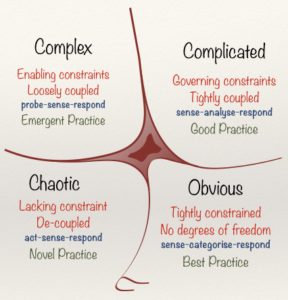
When tapping into experts to make decisions, it’s important to first assess the situation. The Cynefin framework offers five contexts (domains) defined by cause-and-effect relationships: obvious, complicated, complex, chaotic, and disorder.
Cynefin, pronounced “ku-nev-in,” is a Welsh word that means “place” or “habitat.” It was developed in 1999 by scholar David J. Snowden when he worked for IBM Global Services. It gives you a sense of place from which to understand your views about a problem.
The Cynefin Framework. In the center is Disorder. (Source: Own Work – Snowded)
Disorder
The Disorder domain is the starting point. It’s where you don’t know which of the four domains is relevant to your situation.
In this domain, you define the nature of the problem. Beware framing it exclusively around your preferred tools and favorite solutions.
Obvious: The Domain of Best Practice
In the Obvious domain (known until 2014 as simple, more recently renamed to clear by Snowden), the cause and effect relationships are predictable and repeatable. The answers are self-evident to a reasonable person with technical knowledge of the work involved.
Examples are building a house, calculating the interest due on a credit card, and creating a website with a template.
In this domain, you Sense — Categorize — Respond, i.e. you assess the situation, categorize it, and use best practice to respond to it. If the project fails, it is usually due to failure of process, such as not having clear checklists or not following the written script.
Complicated: The Domain of Good Practice
In the Complicated domain, the cause and effect relationships are present, but not obvious. There could be several symptoms of a problem with different solutions. Thus, an expert is needed to pinpoint the exact cause and recommend a solution.
Examples are designing a bridge, fixing a car that won’t start, and figuring out legitimate claims for a lawsuit.
In this domain, you Sense — Analyze — Respond, i.e. you assess the situation, analyze what is known (with help from experts), and use good practice to respond to it. If the project fails, it’s often due to insufficient information on which to analyze the problem.
Complex: The Domain of Emergent Practice
In the Complex domain, the cause and effect relationships are unpredictable and only obvious in hindsight. Business changes, socio-economic restructuring, and political upheaval fall in this category. There are many moving parts; multiple stakeholders with different thoughts, behaviors, opinions and requirements; and problems that are not fully solvable. This is where data can lead to misleading results.
A prime example is managing a global crisis, like COVID-19. In the United States, for example, the country is divided over restrictions, such as self-quarantines, lockdowns, physical/social distancing, and wearing face masks to curb the spread of the virus.
It’s difficult to build trust and provide consistent messaging as data evolves. It’s hard to get unwavering support for guidelines and mandates that affect qualify of life, including economic stability, ability to work, access to education, mental health, social bonds and cultural fabric.
In this domain, you Probe — Sense — Respond, i.e. you test to gather more data, experiment to understand the problem, and look for patterns to allow a solution to emerge. Failure is expected and is part of the learning process. Clear communication and integrated multi-disciplinary teams are key to developing new ideas.
Chaotic: The Domain of Novel Practice
In the Chaotic domain, the cause and effect relationships cannot be be determined. This is an extreme situation where one cannot wait for information to respond. Action is the first and only way to respond.
Examples are the September 11 terrorist attacks (the deadliest on U.S. soil to date) and the collapse of Enron (the largest bankruptcy in U.S. history so far).
In this domain, you Act — Sense — Respond, i.e. you act to establish order, sense where stability lies, and respond to transform the situation from chaotic to complex. Top-down communication and identifying emerging patterns to prevent future crisis are essential.
The boundary between the Obvious and Chaotic domains is unique. If — at the Disorder stage — the problem is wrongly defined as obvious (simple), when it is not, and the work becomes more complicated and there is no appropriate response, the project can slip into chaos.
Simple problems can be solved with known steps. But when the problem is more complex, connecting the dots is more important than making the dots.
2. Manage your focus
Because experts operate in silos, they are less reliable in complex dynamics where you need multiple perspectives. Data overload is a bigger problem when you can’t outsource your thinking to a single expert. You have to look for what’s missing and check your blind spots, rather than depend on an external source.
You need to manage where, how and on what you focus. If you are lost in the details, you easily overlook critical developments, unique opportunities, and potential risks. If you are too focused on the big picture, you miss important details as well as subtle but relevant changes.
3. Consider context
Pay attention to the limits of the information from experts and AI intelligence. Is it relevant to the current context? What was the context in which the data was gathered? Is it similar to or different from your situation?
Here’s an example of why context matters in decision-making:
The Centers for Disease Control (CDC) notes that wearing masks slows the spread of the virus that causes COVID-19. They can reduce the spray of droplets when worn over the nose and mouth, which is important in public settings. The CDC recommends you wear a mask anywhere you will be around other people.
But to date, very little is being said about the possible harms of wearing a mask for extended periods for months on end. If schools fully open up, kids may be required to wear a mask for six to eight hours a day, Monday through Friday, month after month — except for limited activities, like eating and drinking.
Does protracted use of face coverings raise CO2 levels in the blood that could be harmful? Might it increase the severity of the symptoms if you’re infected with the virus but don’t yet know? Does it carry long-term health risks that have yet to be discovered?
So far, there is conflicting data. From a precautionary standpoint, it makes sense to wear a mask in public settings for limited periods. But having kids wear a mask for six to eight hours daily, while in school, is a different context. Because health experts lack clear answers, parents and families need to use their own internal compass to navigate this nuanced issue.
4. Integrate multiple perspectives
Experts have deep knowledge in their specific field. They bring unique skills and experience to the decision-making process. But they have their own biases and agendas, no matter how objective they claim to be. Because their expertise doesn’t cover the entire range of a complex problem, they’re not always better equipped to make decisions for you.
The law of the instrument (Maslow’s hammer) is a cognitive bias that makes us default to familiar tools to solve new problems. If the only tool you have is a hammer, you tend to try and fix everything as if it were a nail, without considering other tools.
Deep expertise has to be complemented with a broad perspective. You ask questions about the expert’s assumptions, motivations and self-interests. You examine whether the proposed solutions are based on replicable research, inconclusive studies, or working hypotheses. You triangulate multiple perspectives from various experts instead of rely on one. You gather pieces of the puzzle from a cross-disciplinary team of experts.
While it takes effort to seek input from a diversity of experts, integrated thinking improves decision quality.
5. Go beyond first-order thinking
A singular problem-solving approach with a single goal is not inherently bad. Sometimes this is necessary in a crisis. But once we move from the Chaotic to the Complex domain, we need to inquire more deeply about the tradeoffs and ripple effects of the initial solution. A more holistic approach is needed to address complex issues that have long-term consequences.
In solving complex problems, it’s not enough to engage in first-order thinking. This means using the most obvious and direct path to get an immediate result, short-term fix, or quick output.
With second-and third-order thinking, you consider the long-term effects and unintentional consequences, which are different from desired outcomes. This means questioning assumptions, exploring other options, and taking stock of the second-order and third-order consequences of your first-order decision.
You gather a wide range of well-reasoned viewpoints to reassess the situation. You work hard to rebut instead of confirm your initial theories and ideas. You make use of devil’s advocates in strategic planning. You invite disagreement without being disagreeable. You open up to competing facts and arguments that challenge deeply held beliefs and cherished positions.
To control the spread of the virus, many U.S. states and some countries imposed lockdowns, which included ordering businesses closed, schools shut, and citizens to self-quarantine at home. The fallout included second-order and third-order effects like high unemployment, bankruptcy filings, education gaps, increased drug use, reduced health screenings, and mental despair.
Dr. David Nabarro of the World Health Organization (WHO) noted that lockdowns are a good tactic for a chaotic situation, where the virus spread is out of control and the health system is likely to be overwhelmed. It’s a way to buy time to reorganize, regroup and rebalance resources. It’s not meant to be a primary control method.
Ivor Cummins, a health activist and biochemical engineer, has published data-driven COVID-19 reports that raise lockdown skepticism. He points out the WHO has broken its own guidelines in 2019 and prior years that advise against quarantines in a pandemic.
There are 10 to 15 published studies concluding lockdowns are ineffective. Cummins notes they work only if you’re an island nation looking to keep the virus out. Once the virus is broadly in the country, there’s no justification for having them, he argues. Because such viewpoints do not fit within the mainstream narrative, they tend to be ignored by the media that thrives on sensationalism and spreading fear.
Today – while the number of COVID-19 positive tests is rising (due in large part to exponential increase in testing) – the death rate is going down, hospitals are not being overrun, and therapeutic treatment is improving significantly. More people die of COVID than with it.
The opposite would have to be true for the COVID-19 situation to turn to chaos and justify lockdowns as a last resort. If implemented, do the benefits outweigh the costs? Is this tool being used inappropriately to control the virus spread when it’s better designed for other purposes?
There is also a push for a COVID-19 vaccine, where safety and effectiveness have to outweigh the risks. Billionaire Microsoft Corporation co-founder-turned-philanthropist, Bill Gates, said in an October 11th interview on NBC’s Meet the Press:
“The only way we’ll get completely back to normal is by having, maybe not the first generation of vaccines, but eventually a vaccine that is super-effective, and that a lot of the people take, and that we get the disease eliminated on a global basis.”
Then he added, “That is where we can finally start taking all the problems that have been created — in education, mental health — and start to build back in a positive way.” (Start at 23:28-minute mark of video.)
In short, Gates proposes a siloed approach to solve a complex global problem. It emphasizes a specific tactic that misses the forest for the trees. It ignores second-and-third-order consequences that might be a higher priority for non-billionaires and less privileged people.
Balance your reliance on experts with common sense
We need experts and artificial intelligence to help us make informed decisions on complex issues. But we also have to skillfully integrate these information sources to capitalize on their value and think for ourselves.
It’s reasonable to consult an expert when you seek to protect your health, pick investments, or solve a legal issue. But no matter how qualified your doctor, financial advisor or lawyer might be, you must also use your common sense and apply your own wisdom.
Dyan Williams is a solo lawyer who practices U.S. immigration law and legal ethics at Dyan Williams Law PLLC. She is also a productivity coach who helps working parents, lawyers, small business owners and other busy people turn their ideas into action, reduce overwhelm, and focus on what truly matters. . She is the author of The Incrementalist: A Simple Productivity System to Create Big Results in Small Steps, an e-book at http://leanpub.com/incrementalist.