I-601 Fraud Waiver + Immigrant Visa Grant = A True Success Story

After USCIS approved the Form I-601 application we prepared on his behalf, our client received his Immigrant Visa and joined his permanent resident parents in the United States. Prior to getting the waiver, he was refused the visa under INA 212(a)(6)(C)(i), i.e. fraud or willful misrepresentation of material fact to previously enter the U.S. on a B1/B2 visitor visa.

With our guidance, he proved to USCIS that his aging mother and father would face extreme hardships if he did not receive admission to the United States. The Form I-601 approval permitted the issuance of Immigrant Visas to the applicant and his accompanying wife and two minor children.

Problem: Permanent Bar Under INA 212(a)(6)(C)(i)

Section 212(a)(6)(C)(i) of the Immigration & Nationality Act (INA) states that a person who, by fraud or willfully misrepresenting a material fact, seeks to procure (or has sought to procure or has procured) a visa, admission to the U.S. or any other U.S. immigration benefit is inadmissible. This is a lifetime bar to entering the United States.

In this case, in the early 1990s, our client attended high school while he was on a visitor visa, instead of on the proper F-1 student visa. A U.S. citizen family friend — who later became his legal guardian — encouraged him to begin attending a U.S. high school during his temporary visits. A minor at the time, he would consistently depart the United States before his authorized stay expired and then re-enter to continue his studies.

Two years later, he was denied admission at a U.S. port of entry, upon presenting his valid passport and unexpired visitor visa. He was still under age 18 at that point. The U.S. customs officers thought he spoke English too well to be just a visitor. With further inquiry, they discovered he was attending school and working part-time in the United States during his temporary stays. His visa was cancelled and he went back to Mexico.

A few days later, he returned to the United States by crossing the U.S.-Mexico border on foot without inspection. He did not encounter any border patrol agents or present any false documents or information to re-enter the United States and finish high school.

Following his high school graduation, he departed the United States and established a comfortable life in his home country. He became a family man with a spouse and two children. He developed a solid career in warehouse management and logistics.

About 20 years later, he applied for an Immigrant Visa based on an approved Form I-130 petition his U.S. citizen brother filed on his behalf. At the Immigrant Visa interview, the U.S. consular officer found him inadmissible under INA 212(a)(6)(C)(i) for misrepresenting the main purpose of his visit when he requested admission to the United States in the mid-1990s on his B-2 visitor visa to continue his education.

During the visa interview, he admitted under oath to the consular officer that he had attempted to enter the United States using his visitor visa by stating he was coming to the U.S. for a visit. But he intended to return to school and a part-time job.

Although he did not affirmatively present false information to the U.S. customs officer, his own testimony at the visa interview led the U.S. Consulate to deny him the visa under INA 212(a)(6)(C)(i). He was instructed to file a Form I-601 application for waiver of inadmissibility.

Solution: Form I-601 Waiver Under INA 212(i)

Section 212(i) of the INA provides a waiver of the fraud/misrepresentation bar if the applicant is the spouse, son, or daughter of a U.S. citizen or permanent resident who will suffer extreme hardship if the applicant’s request for admission to the United States is denied.

After agreeing to represent the applicant, I counseled him on the documentary evidence and written testimonies he needed to present to USCIS. These included detailed affidavits from the applicant and his family members, medical records and psychological evaluation reports for the parents, and proof of his U.S. citizen brother’s limited income and multiple responsibilities.

To support the Form I-601 application, I submitted a legal memorandum describing the extreme hardships the permanent resident parents would suffer if the applicant did not receive the Immigrant Visa for admission to the United States. The memo also explained why his U.S. citizen brother needed his help and support to care for their aging parents. Furthermore, it was not a viable option for the parents to relocate to the applicant’s home country due to the lack of health care, high crime rate, and poor living conditions.

Even if the applicant meets all the eligibility requirements, the USCIS officer must also decide whether to grant the waiver as a matter of discretion. Because fraud or willful misrepresentation of material fact to obtain a U.S. immigration benefit is a serious violation, we emphasized the applicant was a minor, at the time, who reasonably relied on the advice of his legal guardian. In addition, his professional qualifications, family responsibilities, lack of a criminal history, and close relationship with his permanent resident parents were positive factors that outweighed the unfavorable ones.

Outcome: Waiver Approval + Immigrant Visa Grant

Consistent with average wait times, USCIS took a year to process and approve the Form I-601 waiver application. Several months later, the applicant was scheduled for a follow-up interview at the U.S. Consulate, which issued the Immigrant Visas to him and his spouse and two children.

He and his accompanying derivative beneficiaries became permanent residents of the United States upon their admission on Immigrant Visas. He finally reunited with his parents and U.S. citizen brother after they had lived in separate countries for 20+ years. This is a true success story.

Cheers,

Dyan Williams

Founder & Principal Attorney
Dyan Williams Law PLLC
(612) 225-9900
info@dyanwilliamslaw.com

###

This article provides general information only. It is based on law, regulations and policy that are subject to change. Do not consider it as legal advice for your situation. Each case is unique and even cases that seem similar may have different outcomes. The sharing or receipt of this information does not create an attorney-client relationship.

SUBSCRIBE           CONTACT

Intro & Outro Music by: Sebastian Brian Mehr

How to Think Clearly and Make Better Decisions: Part 2 – Frame and reframe the problem

When tackling problems, we often jump into action without thinking deeply about what we are trying to solve. What needs to be tweaked? What needs to be overhauled? What must be kept? What must be scrapped? Is the problem single-rooted or multifaceted? Is there a better problem to solve?

Solving the wrong problems wastes time, resources and energy and might even lead to unintended consequences that make the situation worse. Yet we sometimes overlook how we frame the problem before we set goals, form an action plan, communicate directives, and implement next steps.

Our mental models shape our behavior and influence our perceptions. We use them to deal with uncertainty, make sense of the world, and decide what to do next.

In part 1 of this 3-part article, I discuss how echo chambers condition you to distrust contrary views, arguments and information that disconfirm your cognitive bias. Getting out of your echo chambers helps you understand multiple perspectives, strengthen your thinking, and make fully informed decisions.

The second step to thinking clearly and making better decisions is to frame and reframe the problem before you move forward.

This is especially important in group decision-making, when individuals collectively select a solution from among the alternatives before them. You ask the right questions, use correct framing, and define the problem effectively. Otherwise, you end up with fragile consensus or prolonged gridlock.

In his book, What’s Your Problem?, author Thomas Wedell-Wedellsborg notes, “The way you frame a problem determines which solutions you come up with.” He adds, “By shifting the way you see a problem – that is, by reframing it – you can sometimes find radically better solutions.”

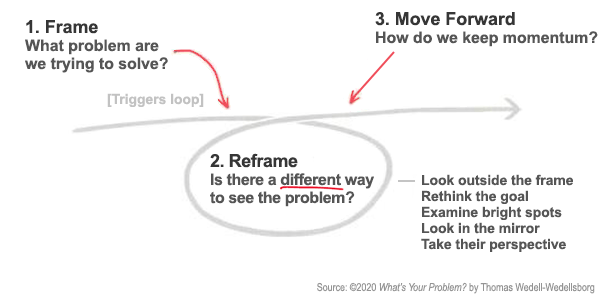
The reframing canvas has 3 parts, with the “reframing loop” as a break in the normal straight line path from defining the problem to moving toward a solution.

1. Frame

Relevant questions are: what’s the problem you are aiming to solve? why exactly is this a problem for people? who’s involved?

This is the initial framing of a problem, which triggers the reframing loop. You examine whether the issue is presented neutrally or is narrowly defined to favor a certain type of solution.

2. Reframe

Relevant questions are: is there a different way to view the problem? what’s missing from the current framing of the problem? are there other factors worth paying attention to? what is the broader context to consider?

This is the redefining of a problem. You zoom out and look outside the familiar frame. You don’t just focus on the visible details, but also unearth the hidden aspects of the situation.

You rethink the goal, which means clarifying higher-level goals, distinguishing facts from beliefs, finding easier or alternative ways to reach a desired outcome, and questioning the goal itself (even if it seems obvious and undoubtedly good).

You examine bright spots (positive exceptions), which are areas of the situation where there are no problems or the problems are not so bad. Consider whether you have ever solved the problem and apply that experience. Look to the past for examples of when the expected problem did not occur, had no ill effects, or was less severe than usual.

Aim to recreate favorable circumstances and positive behaviors that make the bright spot. If you have not previously encountered the problem, look to others — including outside your industry — who have dealt with it or something similar. Frame your problem in more abstract terms instead of getting too specific.

You look in the mirror, which is examining your role in creating the problem. First, you explore your own contribution, e.g. what input did you provide that was reasonable, but didn’t help much?

Second, you scale the problem down to your individual level, instead of keep it at a systems-level. Is there a part of the problem where you have more control and influence? Can you solve it or take action on it on a more local level?

Third, you develop external self-awareness and get an outside view of yourself. How do other people see you? Do you know how your behavior affects others or comes across to others?

You take their perspective, where you seek to understand others’ context and viewpoint, not just their pain or emotions. This is different from having empathy, i.e. feeling what someone else feels.

Step away from your preferences, experiences and emotions and consider how others might see things differently from you. Adopt a benevolent view and assume people intend to do good things. Consider reasonable and innocent explanations for situations that need to be fixed.

3. Move Forward

Relevant questions are: how do you keep momentum? have you tested the problem and worked to frame it properly before you switch into solution mode? how will you validate your problem framing in the real world?

Describe the problem to the stakeholders to develop trust and encourage collaboration. Get outsiders (who are less emotionally invested in your solution) to provide input and feedback. Devise a hard test to determine whether the problem is serious enough for stakeholders to participate in solving it. Test the problem and the solution at the same time through “pretotyping,” i.e. roll out a smaller version of the solution to see if stakeholders show interest and buy into it.

Revisit the problem and possibly reframe it through regular intervals and scheduled check-ins. You could hold a daily, weekly or monthly staff meeting to review progress and results, especially in fast-changing situations. Contexts and priorities can change and new data and information can be gained as you move forward.

Frame and reframe the problem before you keep pursuing a course of action

Before you decide on a course of action, ask whether there are alternative and better ways to frame the problem. Are there important nuances being overlooked? Is the problem really one that needs solving? Have you fallen in love with a solution before fully understanding the problem?

The way you define a problem affects the depth and breadth of proposed solutions. Whether you’re providing legal advice, building a marketing strategy, addressing client needs or hiring a team member, pay close attention to how you frame the problem in the first place. Reframing is a powerful tool to address pertinent issues, rethink objectives, and move forward in a positive direction.

Reframing involves seeing the big picture. Only then will you be able to consider the situation with different perspectives and from diverse viewpoints. It’s not about defining the real problem, but more about examining different aspects of the problem to create better solutions.

Wedell-Wedellsborg offers a simple example known as The Slow Elevator Problem. The initial problem statement, “The elevator is too slow,” generates proposed solutions to make it faster, e.g. upgrade the motor, improve the algorithm, and install a new elevator. Although these solutions might work to reduce customer complaints, they tend to be costly.

When building managers reframe the problem to “The wait is annoying,” this leads to easier and less costly solutions that make the wait feel shorter, e.g. put up mirrors, install hand sanitizers, and play music. And a better problem is solved to reach a desired outcome, which is higher customer satisfaction.

Reframing means you dig deeper into how the problem is initially framed (explore the frame) or move away from the initial framing of the problem (break the frame). When you use the power of reframing, you gain an improved understanding of the issues, avoid focusing on the wrong problem, and invest resources on a problem really worth solving.

*  *  *

For more information on thinking clearly and making better decisions, read part 1 (Get out of echo chambers) and part 3 (Keep experts on tap, not on top) of this multipart article.

# # #

Dyan Williams is a solo lawyer who practices U.S. immigration law and legal ethics at Dyan Williams Law PLLC. She is also a productivity coach who helps working parents, lawyers, small business owners and other busy people turn their ideas into action, reduce overwhelm, and focus on what truly matters. . She is the author of The Incrementalist: A Simple Productivity System to Create Big Results in Small Steps, an e-book at http://leanpub.com/incrementalist.

SUBSCRIBE           CONTACT

How to Think Clearly and Make Better Decisions: Part 1 – Get out of echo chambers

The ability to think clearly is essential to making better decisions – whether you’re launching a new product, defining a legal strategy, or managing a pandemic. But cognitive biases affect the way we frame issues, interpret data, and come up with ideas.

The human brain is naturally wired to find simple answers, not seek objective truth. It looks for patterns to automate repetitive tasks and decisions. It settles on data points that fit with current perceptions, which may be flawed. While this is fine for routine matters, it can lead to serious errors in high-stakes situations.

It’s not enough to be aware of your blind spots and how they shape beliefs, drive emotions, and influence actions. You also need to safeguard against default thinking on complex issues.

No one is entirely objective in processing information. Cognitive biases are a part of human nature. One of the most common and damaging type is confirmation bias. This leads us to seek out and recall facts that confirm what we already believe or think, and disregard and overlook competing facts that support a different view.

Confirmation bias contributes to division and polarization, where right-wrong, good-evil, dichotomous thinking prevails. Bias, by itself, doesn’t necessarily make you wrong or more intolerant of others you disagree with. But when you don’t see the whole picture (i.e. objective facts and evidence), and see only what you want to see (i.e. facts and evidence confirming your beliefs), you end up with suboptimal solutions.

The first step to thinking clearly and making better decisions is to get out of your echo chambers.

In echo chambers, you are conditioned to distrust contrary views, arguments and information from the “other side.” Competing ideas, beliefs and data points are blocked or ignored. This keeps us in an epistemic bubble, where one is unexposed to contrary views, arguments and information from the “other side.”

Virtual echo chambers

Echo chambers distort reality and manipulate your impression of others. Social media, social networks, and online discussion sites like Facebook, Twitter, and Reddit amplify and reinforce biases. Through AI algorithms, search engines (e.g. Google and Yahoo) and content delivering websites (e.g. YouTube) give us more of what we want and less of what we don’t want. They can also suppress certain types of information.

In today’s attention economy, the most extreme viewpoints and sensationalized headlines get the most clicks. Individuals with neutral or moderate positions tend to avoid the debate, get sucked into the extremes, or are deemed to be clueless.

While modern technology like the Internet allows us to connect regardless of physical distance, it also has its drawbacks. Compared to face-to-face interactions, online communication makes it easier to express outrage over things you oppose and show less tolerance of competing beliefs.

Trolling, cyberbullying and other hostile online behavior are not uncommon, particularly in anonymous postings and through anonymous social media accounts. A faux pas that would be shrugged off or easily resolved in person becomes a major disagreement on the Internet.

Determining intent and understanding context in Twitter feeds, social media content, and even email is difficult. Words have different meanings and may affect each person differently. When we agree with the author’s viewpoint, we tend to assume their values, beliefs and perceptions are in line with our own. When we don’t, we might stereotype and label them negatively.

Communicating on a public medium often makes people more defensive and less likely to concede on valid points or point out areas of agreement. Use private online chats and direct messaging if you really want to encourage healthy discourse.

There is excess information, misinformation, filtered information, and conflicting information. For example, on issues of political controversy, check out both liberal leaning media (e.g. New York Times, MSNBC, The American Independent) and conservative leaning media (e.g. Wall Street Journal, Fox News, Brietbart).

Then search for unmoderated and less exciting information from more independent sources like C-SPAN. You could also tune into YouTube talk shows and podcasts covering in-depth and nuanced conversations on topics of interest.

Being exposed to opposing arguments will burst your epistemic bubble. But it won’t necessarily change your views or shift your positions — especially if you’ve learned, within your echo chamber, to distrust outside sources. Access to more information creates more opportunities to confirm biases. You might feel vindicated (when you receive confirming information) or disgusted (when you receive disconfirming information).

For concessions and agreements to be reached, each side has to earn the other’s trust, which is hard to do. Stay curious. Stay humble. Take time and make space for a well thought-out response, instead of give in to an immediate reaction.

Sometimes you need a digital detox. Read a book instead. Unplug from your devices such as smartphones, televisions, computers, and tablets. Limit your use of social media and get the apps off your phone. If you feel compelled to stay informed, a one-time check at the end of the day is usually more than enough.

Get a good night’s sleep, move, eat well, and practice mindfulness to help you avoid snap judgments. Self care helps you activate the prefrontal cortex of your brain, which is responsible for self-control, critical thinking and decision-making. Go for a long walk or sit in a quiet spot to reflect on information when you’re not emotionally charged and can think more calmly and objectively.

Real-life echo chambers

If you want to detect your blind spots, invite a free exchange of ideas and active discourse with friends, family members and colleagues who hold different beliefs and opinions.

Each must act in good faith, i.e. listen with curiosity, respect divergent viewpoints, refrain from proving the other side wrong or changing the other person’s mind, and find points of agreement. Some individuals are capable of having civil discussions; others are not. Choose wisely.

Discuss the strongest version (steel man) instead of the weakest version (straw man) of the person’s opposing viewpoint. Question what exactly they mean when they use vague terms or loose labels. Engaging in dialectic discourse sharpens your critical thinking skills. It allows you to poke holes at your own biases and recognize either side could be right or wrong. No one has a monopoly on truth, especially on complex and evolving issues.

Ward off first impressions. Avoid making assumptions about the person’s reasons for a particular position. It could be entirely apolitical and based on a common set of ideals. Perhaps your hierarchy of priorities and values simply do not match exactly with theirs. Maybe you just disagree on the approach in reaching a shared objective.

When we consider others’ perspectives and how they came to hold the beliefs and opinions they do (whether through logic or emotion), we can develop more compassion, engage in productive discourse, stop fighting, and learn from each other.

Silo thinking leads us to ignore objective facts, see only what confirms our biases, and overlook important data that do not match preconceptions. Merely getting out of your echo chamber is not enough for you to adapt to new information or change preexisting beliefs. But it will help you understand multiple perspectives, strengthen your thinking, and make fully informed decisions.

* * *

To learn more about thinking clearly and making better decisions, read part 2 (Frame and reframe the problem) and part 3 (Keep experts on tap, not on top) of this multipart article.

# # #

Dyan Williams is a solo lawyer who practices U.S. immigration law and legal ethics at Dyan Williams Law PLLC. She is also productivity coach who helps working parents, lawyers, small business owners and other busy people turn their ideas into action, reduce overwhelm, and focus on what truly matters. She is the author of The Incrementalist: A Simple Productivity System to Create Big Results in Small Steps, an e-book at http://leanpub.com/incrementalist.

SUBSCRIBE           CONTACT

Staying Abroad Too Long May Affect Eligibility for Naturalization

In general, to qualify for naturalization, you must have resided continuously in the U.S. for at least 5 years, as a permanent resident, to become eligible for naturalization. An exception is if you are a qualified spouse of a U.S. citizen, in which case your continuous residence must be at least 3 years to qualify for naturalization.

You must also maintain continuous residence from the time you file the Form N-400 up to the time of naturalization (i.e. take the naturalization oath and become a U.S. citizen).

Normally, you may file your naturalization application up to 90 days before reaching the 3/5-year continuous residence period. This is known as the 90 day early filing period.

Your LPR status begins when USCIS approves your adjustment application or when you are admitted to the U.S. on an immigrant visa. For certain groups, the start date of becoming an LPR may be earlier than the actual approval of the status (commonly referred to as a “rollback” date). For example, USCIS generally considers an asylee’s date of admission as an LPR to be one year prior to the date the adjustment application was approved.

Breaks in Continuity of Residence

Continuous residence involves your maintaining a permanent dwelling place or principal residence in the United States over the period of time required by the statute. The federal regulation defines residence as your domicile or principal actual dwelling place, without regard to your intent. The duration of your residence is calculated from the time you first establish residence in a particular location.

Thus, if you list a foreign residence and no concurrent U.S. physical address on the naturalization application, during the 3/5-year statutory period, you could face problems meeting this requirement.

If you broke the continuity of residence because you stayed abroad too long, you may not file your naturalization application as early as 90 days before you meet the continuous residence requirement.

Continuous residence relates to the time you resided lawfully in the U.S. without any single absence long enough to “break” continuity for naturalization. There are two types of absences from the U.S. that break the continuity of residence for purposes of naturalization:

1.  Absence of more than 6 months but less than one year is presumed to break the continuity of residence.

Example: Melinda is absent from the U.S. from September 19, 2017 to June 26, 2018. Her absence of 280 days is presumed to break the continuity of residence because it lasted more than six months. Any time spent in the U.S. prior to September 19, 2017 presumably does not count toward her continuous residence.

She may, however, rebut the presumption of a break in continuous residence to be eligible for naturalization. She must provide evidence showing she did not disrupt her continuous residence during her stay abroad, such as keeping her job in the U.S. and not obtaining employment while abroad; maintaining a physical residence in the U.S. to which she retained full access (e.g. own or lease a home); and having immediate family members or strong family ties in the U.S.

Eligibility After Break in Continuous Residence (due to absence of more than 6 months but less than one year): Rebut presumption OR Wait at least until 6 months before reaching the end of the new statutory period

If the applicant is unable to rebut the presumption of a break in continuous residence, she must establish a new period of continuous residence to be eligible for naturalization.

Thus, if Melinda does not rebut the presumption of a break in continuous residence, she must wait until at least 6 months from reaching the 5-year anniversary of the new statutory period following her return to the United States. In this example, the new statutory period began on June 26, 2018, which is when Melinda returned to the United States. The earliest she may apply (or re-apply) for naturalization is December 26, 2022, i.e. at least 6 months from the end of the relevant statutory period.

2. Absence of one year or more (without an approved Form N-470, Application to Preserve Residence for Naturalization Purposes) absolutely breaks the continuity of residence.

Example: Jonas was absent from the United States from December 11, 2014 to January 11, 2016. His absence of 396 days absolutely breaks the continuity of residence because it lasted more than a year. Any time spent in the U.S. prior to December 11, 2014 does not count toward his continuous residence.

Unless the applicant has an approved  Form N-470, Application to Preserve Residence for Naturalization Purposes, USCIS must deny a naturalization application for failure to meet the continuous residence requirement if the applicant has been continuously absent for a period of 1 year or more during the statutory period. A Form N-470 preserves residence for LPRs who have qualifying employment abroad with the U.S. government, private sector, or a religious organization.

Eligibility After Break in Continuous Residence (due to absence of one year or more): Four Years and One Day | Two Days and One Day OR Four Years and Six months | Two Years and Six Months

When there is an absolute break in continuous residence due to absence of one year or more:

You must wait at least 4 years and 1 day after re-entering and continuously residing in the U.S. to file for naturalization, if you are subject to the 5-year continuous residence requirement. (Once 4 years and 1 day have passed from the date of your return to the United States, the period of absence from the United States that occurred within the past 5 years is now less than 1 year.)

You must wait at least 2 years and 1 day after re-entering and continuously residing in the U.S. to file for naturalization, if you are subject to the 3-year continuous residence requirement. (Once 2 years and 1 day have passed from the date of your return to the United States, the period of absence from the United States that occurred within the past 3 years is now less than 1 year.)

Merely counting out 4 years and 1 day or 2 years and 1 day from your return to the U.S. — following an absence of 1 year or more — is not sufficient to determine whether you meet the continuous residence requirement. Because the period of absence within the past 5 years (or 3 years) is still more than 6 months, you must also overcome the presumption of a break in continuous residence.

But if you wait to apply for naturalization at least 4 years and 6 months (or 2 years and 6 months) after returning to the United States and reestablishing residence, there would not be a presumption of a break in residence. The reason is the period of absence preceding the N-400 application date is now less than 6 months.

How Absence from the United States During the Statutory Period Affects Eligibility to Naturalize:

Duration of AbsenceMust Applicant Overcome Presumption of a Break in the Continuity of Residence?Eligible to Naturalize?
6 months or lessNo *(See Note 1 below)Yes
More than 6 months but less than 1 yearYesYes * (See Note 2 below)
1 year or more (without USCIS approval via N-470 process)Not eligible to applyNo

*NOTE 1:  Absences of less than 6 months may also break the continuous residence depending on the facts surrounding the absence. An example is if you claimed nonresident alien status to qualify for tax exemptions or if you failed to file income tax returns because you consider yourself a non-resident alien.

*NOTE 2: If you are unable to rebut the presumption of a break in continuous residence, you must wait to apply for naturalization at least 6 months before reaching the end of the relevant statutory period. Example: if you returned to the United States on June 26, 2018, following an absence of more than 6 months but less than 1 year — and you’re unable to rebut the presumption of a break in continuous residence — the earliest you may apply (or re-apply) for naturalization is December 26, 2022.

Length of Time Needed to Re-Establish Eligibility for Naturalization and Residence in the United States Following An Absence of 1 Year or More:

ProvisionAbsence During Statutory PeriodMay Apply for Naturalization After…
INA 316
5-year statutory period
More than 1 year4 years and 6 months, OR 4 years and 1 day (but must overcome presumption of break in continuous  residence)
INA 319
3-year statutory period
More than 1 year2 years and 6 months, OR 2 years and 1 day (but must overcome presumption of break in continuous residence)

Permanent dwelling place in the U.S.

You must have the intent to maintain lawful permanent resident status and consider all absences from the U.S. to be fixed, temporary visits abroad. Lengthy or frequent absences from the U.S. may result in a denial of naturalization due to  abandonment of LPR status.

USCIS will consider the entire period from the LPR admission until the present when determining whether you meet the continuous residence requirement. It will focus mostly on whether you maintained continuous residence (permanent dwelling place) in the United States during the statutory period.

If you have taken a trip outside the U.S. that lasted 6 months or more since becoming a permanent resident, you should have evidence that you continued to maintain a permanent dwelling/physical address in the United States and kept ties to the U.S. during your absence.

Frequent trips or stays abroad, even when each lasted less than six months, can also create problems. If you’re not able to show your principal actual dwelling place is in the United States or show residence within the United States for the statutory period, USCIS may find that you do not meet the continuous residence requirement, even if all of your individual absences were under 6 months.

For more information on eligibility for naturalization, read our related article, 5 Questions to Ask Yourself Before You File for Naturalization (U.S. Citizenship). Consult a U.S. immigration attorney to verify when you may file for naturalization, especially if you had a trip abroad lasting more than 6 months during the statutory period.

This article provides general information only. It is based on law, regulations and policy that are subject to change. Do not consider it as legal advice for any individual case or situation. Each legal case is different and case examples do not constitute a prediction or guarantee of success or failure in any other case. The sharing or receipt of this information does not create an attorney-client relationship.

SUBSCRIBE           CONTACT

SEVP Modifies COVID-19 Exemptions for F-1 and M-1 Students: In-Person Classes Required in Fall 2020

On Monday, July 6, the Student and Exchange Visitor Program (SEVP) announced changes to the exemptions for F-1 and M-1 students taking online classes due to the pandemic. Under the new policy, international students may not remain in the U.S. to take a full online course load in Fall 2020 without accruing unlawful presence and being subject to removal (deportation) proceedings. F-1 and M-1 visas or admissions to the U.S. in such status will not be given to students enrolled in schools and/or programs that are fully online for the fall semester.

What is the New Policy?

The SEVP is part of the U.S. Immigration & Customs Enforcement (ICE). A July 6 announcement on ICE’s website lists the changes to temporary exemptions for the fall 2020 semester:

1. Nonimmigrant F-1 and M-1 students attending schools operating entirely online may not take a full online course load and remain in the United States. The U.S. Department of State will not issue visas to students enrolled in schools and/or programs that are fully online for the fall semester nor will U.S. Customs and Border Protection permit these students to enter the United States. Active students currently in the United States enrolled in such programs must depart the country or take other measures, such as transferring to a school with in-person instruction to remain in lawful status. If not, they may face immigration consequences including, but not limited to, the initiation of removal proceedings.

2. Nonimmigrant F-1 students attending schools operating under normal in-person classes are bound by existing federal regulations. Eligible F students may take a maximum of one class or three credit hours online.

3. Nonimmigrant F-1 students attending schools adopting a hybrid model — that is, a mixture of online and in person classes — will be allowed to take more than one class or three credit hours online. These schools must certify to SEVP, through the Form I-20, “Certificate of Eligibility for Nonimmigrant Student Status,” certifying that the program is not entirely online, that the student is not taking an entirely online course load this semester, and that the student is taking the minimum number of online classes required to make normal progress in their degree program. The above exemptions do not apply to F-1 students in English language training programs or M-1 students pursing vocational degrees, who are not permitted to enroll in any online courses.

Schools are instructed to update their information in the Student and Exchange Visitor Information System (SEVIS) within 10 days of the change if they begin the fall semester with in-person classes but later switch to only online classes, or a nonimmigrant student changes course selections, and as a result, ends up taking an entirely online course load.

What are the Effects of the New Policy?

F-1 students pursue academic coursework while M-1 students pursue vocational coursework in the United States.

U.S. federal regulation at 8 CFR 214.2(f)(6)(i)(G) states that F-1 students may take only one online class or 3 credits per session, term, semester, trimester or quarter that count toward their degree or full course of study requirement. 8 CFR 214.2(m)(9)(v) states M-1 students may not count online courses toward a full course of study.

An online course is one that does not require physical attendance for classes, examination or other activities integral to course completion. It is offered primarily through the use of television, audio, or computer transmission.

Previous COVID-19 Exemptions

On March 9, 2020, SEVP issued guidance titled Coronavirus Disease 2019 (COVID-19) and Potential Procedural Adaptions for F and M nonimmigrant students. This prior policy allowed F and M students to continue studies by taking online courses in the spring and summer semesters to meet federal regulations. It allowed them to take more online courses during the COVID-19 pandemic than what is permitted by federal regulations.

There was no requirement prohibiting a full online course load or any other restrictions for F and M students enrolled and already in the U.S. The SEVP permitted schools to change their procedures to comply with state or local state health emergency rules. Schools were not required to give prior notice of these changes and only had to report changes to SEVP within 10 business days.

Updated COVID-19 Exemptions

As of Fall 2020, the updated policy makes in-person classes mandatory for F and M students to meet the full-time course study requirements. This is a shift from the more flexible COVID-19 exemptions that SEVP gave to schools and students for the spring and summer semesters of 2020.

Nonimmigrant Students in the United States

Current F and M students may not take a full online course load and remain in the United States without violating the law. If students find all their courses will be online, they must leave the country or seek to maintain their status such as by requesting authorization for a reduced course load or switching to a school that offers in-person classes. Students who fall out of status and accrue unlawful presence are subject to being put in removal proceedings before an Immigration Court.

Normal In-Person Classes

If the school offers normal in-person classes, F students must comply with federal regulation by taking only one online class or 3 credit hours per session, term, semester, trimester or quarter.

Hybrid Model with In-Person and Online Classes

If the school offers a hybrid model with a combination of in-person and online classes, F students may take more than one online class or three credit hours online.  What this really means is that the class includes a mix of online lectures or activities and in-person lectures or activities. Hybrid schools must certify on the Form I-20 that the program is not fully online, the student is not taking an entirely online course load, and the student is taking the minimum number of online classes for Fall 2020 to make normal progress.   

No Online Classes for F-1 Students in English Language Training Programs or M-1 Students

None of the exemptions for taking online classes, including the hybrid model, are allowed for F students in English Language training programs or for M-1 students pursuing vocational degrees.  The regulations at 8 CFR 214.2(f)(6)(i)(G) and 8 CFR 214.2(m)(9)(v) do not permit online classes for such students.

[UPDATE, July 15, 2020: U.S. district judge Allison D. Burroughs announced on Tuesday, July 14, that the Trump Administration had agreed to back down in a lawsuit over the policy filed by Harvard University and the Massachusetts Institute of Technology. Previous COVID-19 exemptions — which allow foreign students to remain in the U.S. to study even if their classes have all moved online — will continue to apply. The new policy will apply only to incoming students.]

Nonimmigrant Students Outside the United States

The U.S. Department of State (U.S. Embassies and Consulates) will not issue F and M visas to applicants who plan to attend schools that offer courses entirely online in Fall 2020.

Even if they have a valid F or M visa, students will not be admitted to the United States by CBP if all the program-related courses are online only for Fall 2020.

Form I-20 Updates

F and M students must get an updated Form I-20, Certificate of Eligibility for Nonimmigrant Student Status, stating the school is not operating in full online courses mode and the student is not taking full online courses for Fall 2020 semester. This information goes in the Remarks field of the I-20.

SEVP plans to re-issue I-20s for Fall 2020 within 21 business days of the announcement (i.e. by August 4, 2020). Priority will be given to fall 2020 students arriving from outside the United States.

Current F-1 students with approved Curricular Practical Training (CPT) during program studies or with approved Optional Practical Training (OPT) or STEM OPT after program completion may remain in active status and continue their training.

Continuing F and M students, whose schools offer only online courses for Fall 2020, can keep active status if they stay outside the United States and take full online courses to meet visa requirements. They must get a new I-20 indicating they are abroad taking a full course load as the school is offering only online courses for Fall 2020.

Conclusion

The updated policy is not fully clear and schools are awaiting further guidance from SEVP, ICE. The student visa restrictions were introduced soon after the pandemic-related suspension on H, L and J visa and certain immigrant visas.

With the ending of the temporary exemptions that were granted back in March, F and M students may not lawfully remain in the United States if their school goes fully or, in some cases, partly online. To maintain status or to receive a visa or entry to the United States, the student has to take in-person classes or, in the case of F-1 students, classes that involve a mix of in-person and online attendance.

Schools that planned to operate remotely, in COVID-19 times, might need to rethink their strategy to keep their F and M students. Schools that do not at least offer a hybrid model of in-person and online classes will face a significant loss in revenue (tuition and fees from international students).

The updated policy could serve as a catalyst for colleges and universities to reopen campuses, as states continue to lift restrictions that were implemented to curb the spread of the novel coronavirus. There is flexibility in that schools may use hybrid models that are not 100% online to keep F-1 students.

Some international students might not want to bear exposure to the virus by attending classes in person. But, under the new rule, this is unavoidable if they wish to maintain their status or to obtain an F-1 or M-1 visa and be admitted to the United States for the Fall 2020 semester.

###

This article provides general information only. It is based on law, regulations and policy that are subject to change. Do not consider it as legal advice for any individual case or situation. Each legal case is different and case examples do not constitute a prediction or guarantee of success or failure in any other case. The sharing or receipt of this information does not create an attorney-client relationship.

SUBSCRIBE           CONTACT